
Most guides to travelling with a dog give you a list. Microchip, rabies vaccination, health certificate, tapeworm treatment. The list is easy. It's on every government page and every vet's noticeboard.
The list is not what goes wrong. What goes wrong is the order, because several of these steps are only valid if they happened in the right sequence, and a step done in the wrong week can be worth nothing at all. You can hold every item on the list and still be turned around at the border.
Here is the sequence, and where the traps are.
1. Microchip, and it has to come first #
Your dog needs a microchip meeting the technical requirements in the EU rules on pet traceability. Nearly every chip fitted by a vet in the last fifteen years already does.
The part that matters is the timing. EU guidance is direct about it: to be valid, your pet must have been microchipped before the rabies vaccination is given. Great Britain applies the same order.
So if your dog was vaccinated against rabies and chipped afterwards, that vaccination does not count for travel. Not "counts with paperwork", not "your vet can note it". It has to be done again, after the chip. Plenty of dogs vaccinated years ago as part of ordinary care are in exactly this position, and the owner has no reason to suspect a problem until a vet checks the dates.
Check which came first before you plan anything else. It is the one piece of this that can cost you a month.
2. Rabies vaccination, then 21 days of nothing #
The vaccination itself is the easy part, once the chip is in. EU rules require the dog to be at least 12 weeks old for its first vaccination.
Then you wait. At least 21 days after the first or primary vaccination before travelling, under both EU and GB rules. Great Britain words it as 21 full days after the first vaccination, or after the last of the first course.
That wait is the reason pet travel cannot be arranged in a hurry. Three weeks is not a formality you can shorten with a fee. If the vaccination happens on the wrong day, your travel date moves.
Boosters are different. Keep the course running without letting it lapse and you do not restart the 21 days. Let it lapse, and the next one counts as a primary vaccination again, with the full wait attached.
3. The document depends on where you are coming from #
Two different pieces of paper do this job, and which one you need is a question about your starting point rather than your destination.
Travelling from an EU country or Northern Ireland to another EU country, a valid European pet passport covers it. It is issued once and stays with the dog.
Coming from a non-EU country, you need an EU animal health certificate instead, and this one has a clock on it: it must be issued not more than 10 days before your pet arrives in the EU. It is a per-trip document, not a permanent one.
For Great Britain, the accepted document depends on the country you are travelling from, so check the current GOV.UK guidance rather than assuming the document that worked last time still applies.
4. The tapeworm window, measured in hours #
This is the step that needs a calendar reminder rather than a mental note, because it is the only one with a window that opens and closes.
Some destinations require treatment against the Echinococcus multilocularis tapeworm shortly before arrival. On the EU side that means Finland, Ireland, Malta, Norway and Northern Ireland, and the treatment has to be given between 24 and 120 hours before travel. It is not required for dogs travelling directly between those five.
Great Britain requires it for dogs too, no less than 24 hours and no more than 5 days before arrival.
Read that as a window rather than a deadline. Too early fails just as surely as too late. It has to be administered and recorded by a vet, which means finding an appointment inside a five-day slot that may fall on a weekend, in a country you are already visiting. That is the step worth booking well ahead.
Working backwards from the travel date #
Once you see the shape of it, the whole thing is a countdown rather than a checklist. The microchip has no deadline but blocks everything after it. The vaccination needs 21 clear days. The health certificate cannot be issued more than 10 days out. The tapeworm treatment has to land in a window a few days wide.
Four steps, four different relationships to the same date, and they do not sort themselves into a sensible order by instinct.
This is the problem Pupport was built around. You give it the destination and the travel date, and it lays the steps out against that date, telling you what is already done and when each remaining one opens.
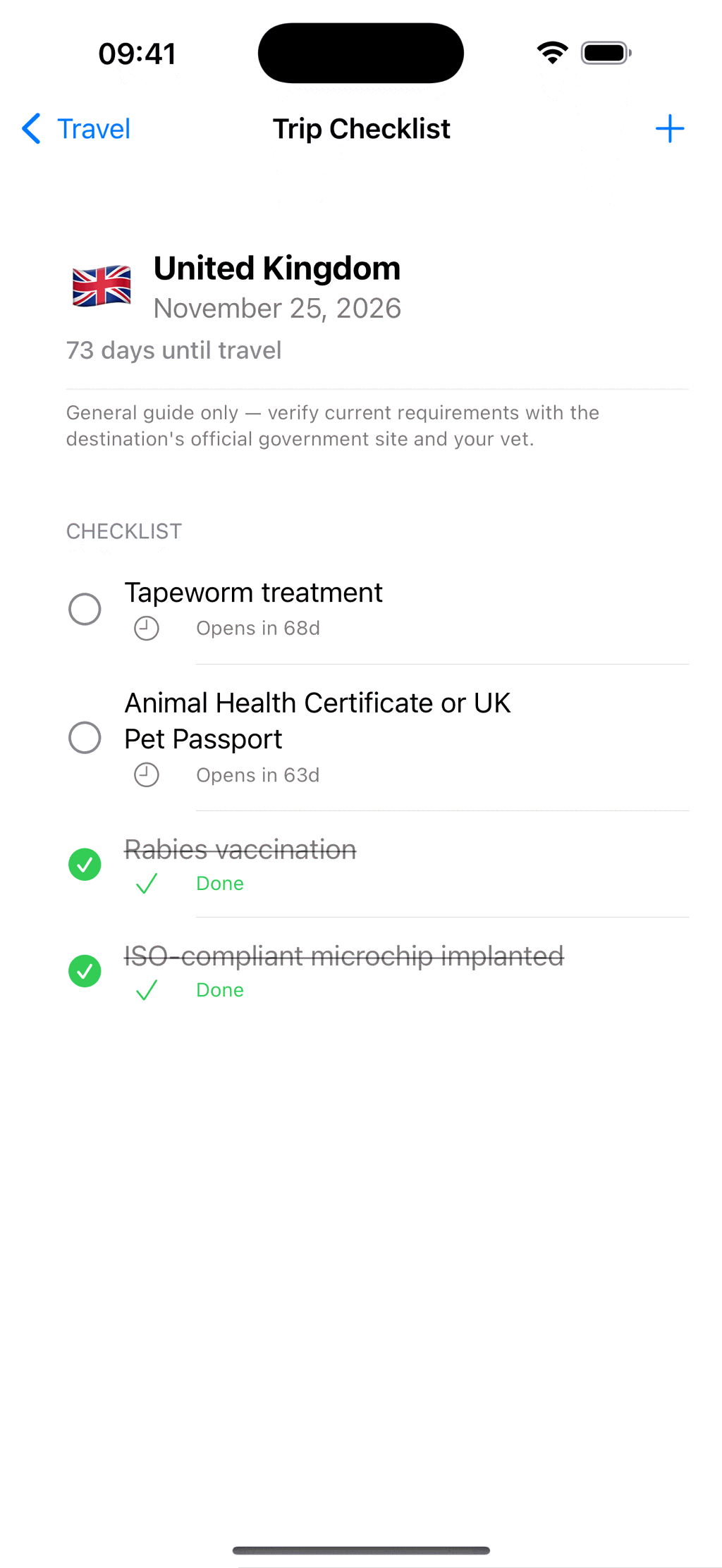
It also keeps the documents themselves. You scan a vaccination record, a passport or a vet note with the camera, it reads the dates on the device, and each document is filed under the right dog. Useful when you are asked for a date at a counter and the paperwork is in a drawer at home. It covers the EU and EEA, the United Kingdom, the United States, Australia and Japan, works for households with more than one dog, and it is free with no account and no network call of any kind.

Check the official source before you travel #
Everything above is accurate as of September 2026, and every specific requirement is linked to the government page it comes from. Treat it as an explanation of how the pieces fit together rather than as authority.
Pet import rules change, they differ by destination, and the tapeworm list in particular has moved over the years. Before you book anything, read the current guidance on the official site for your destination, and talk to your vet about your dog's own dates. Pupport shows the same warning on every checklist, for the same reason.
Two official starting points:
- Travelling with pets and other animals in the EU, the European Commission's Your Europe guidance
- Taking your pet dog, cat or ferret abroad on GOV.UK
Getting it wrong is expensive in a way that matters. GOV.UK notes that a pet arriving without the right paperwork can face quarantine for up to four months, or be refused entry if you travelled by sea. The paperwork is tedious. It is considerably less tedious than that.
Related Articles #
- Pupport app page: document scanning, weight tracking, travel checklists, and the App Store link
- Which Houseplants Are Actually Safe for Cats and Dogs: the other thing that catches pet owners out, with the ASPCA lists behind it