
The Schengen short-stay rule sounds simple enough to do in your head. Ninety days out of every hundred and eighty. Most people hear that and picture two halves of a year: three months in, three months out, start again.
That picture is wrong in a way that quietly produces overstays, and the people it catches are usually the ones travelling most carefully.
The rule, stated properly #
You may stay a maximum of 90 days in any 180-day period.
The load-bearing word is any. The 180-day period is not a calendar block that begins when you first arrive and ends six months later. The European Commission describes it as a moving window, calculated by looking backwards from each day of your stay.
So the actual test is this. Stand on any date. Look back exactly 180 days from it. Count every day you were physically inside the Schengen area in that stretch. That number must not be above 90. Then do the same thing tomorrow, and the day after, because the window has moved.
There is no reset. No anniversary, no fresh allowance after a trip home, no moment where the counter goes back to zero. Days leave the count one at a time, 180 days after each one happened, which means your available balance is different every morning.
Both ends of the trip cost a full day #
Under EU rules the date of entry counts as the first day of stay and the date of exit counts as the last day of stay.
That means a partial day is a whole day, twice per trip. Land at 23:40 and you have spent a day. Fly out at 06:00 and you have spent another. A weekend that feels like two days on the ground is four days against your allowance if the flights fall badly.
Over a year of short trips this is where the arithmetic drifts. Nobody misremembers a two-week holiday. People do lose track of eight weekend trips, each quietly costing a day more at each end than it felt like.
Why the mental version fails #
Three things make this genuinely hard to hold in your head, and none of them are about being bad at arithmetic.
The window moves. A fixed period you could track on a wall calendar. A window that slides forward daily means every answer has a date attached, and an answer from last week is not an answer for today.
The question is always about a future date. What you usually want to know is not "how many days have I used" but "if I fly on the 12th and come back on the 26th, am I fine". That means running the count forward against a window that will itself have moved by then.
The evidence used to be a page of ink, and now it is not. This is new. The EU Entry/Exit System started operating on 12 October 2025 and became fully operational on 10 April 2026 across all 29 participating countries. It records each crossing digitally, with biometric data, and it replaced the stamping of passports.
For border control that is a clear improvement, and overstayers are now detected automatically. For you, it removes the shabby but useful habit of flipping through your passport and adding up stamps. The record exists, it is more accurate than the ink ever was, and it is not in your pocket.
The rule itself did not change on 10 April. The bookkeeping did, and so did the chance of an accidental overstay going unnoticed.
What to do instead #
Use the official calculator for anything consequential. The European Commission publishes a short-stay calculator that implements the rule as the authorities apply it. Before you book a trip that lands anywhere near the limit, put the dates in there. It is the reference implementation, and nothing else you use is authoritative next to it.
Keep your own dated record. The calculator only knows what you tell it, so its answer is only as good as your memory of the last six months of travel. Reconstructing that from boarding passes and bank statements the night before a flight is exactly when mistakes get made.
Leave margin. Treat 90 as a hard ceiling rather than a target. Border officers apply the rule to the day, and the consequences of being one day over are wildly out of proportion to the benefit of one extra day.
Keeping the record without thinking about it #
This is the job Stamp Days does. It notices when you change country, using a significant location change and a reverse geocode, and counts the days you spend in each one. The dashboard shows where you are and what day you are on, and the trip history is grouped by month with entry and exit dates you can edit.
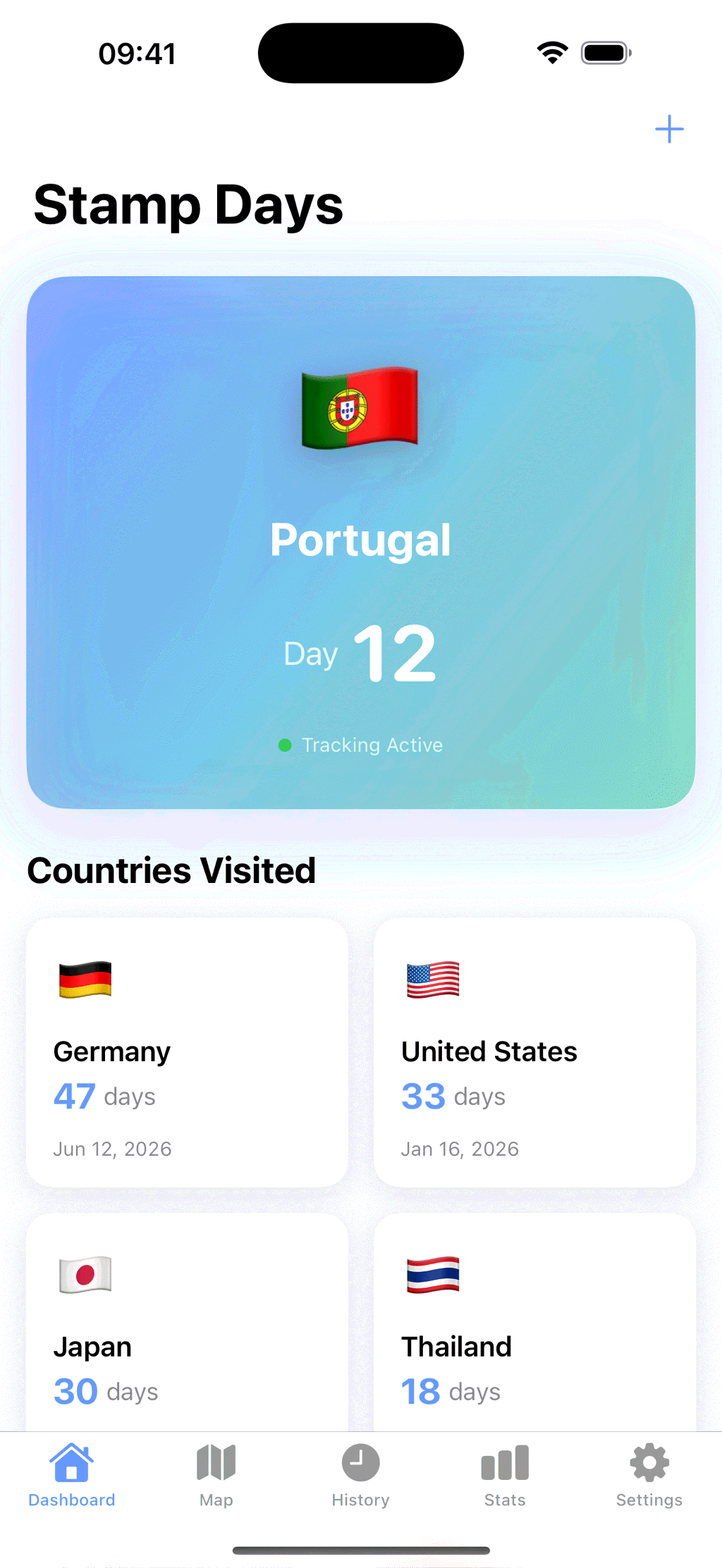
Two details worth knowing. You can backfill past trips over any date range, including ones from before you installed it, which matters because a 180-day window reaches back further than a newly installed app can see. And there is a manual mode that sets the country by hand and uses no location data at all, if background tracking is not something you want.
It is free, with no account. It also tracks US states, entered by hand, because the geocoder answers with a country rather than a state.
What it gives you is a dated history of where you actually were. That is the input the official calculator needs, and the part your memory is worst at.

One caveat worth stating plainly #
No app, this one included, decides whether you are compliant. Border authorities do, working from the Entry/Exit System record.
Use a day counter to know where you stand and to keep an accurate history. Use the official short-stay calculator to check any trip that comes close to the limit. If your situation involves a visa, a residence permit, a long-stay national visa or a bilateral agreement, the plain 90/180 arithmetic may not be the rule that applies to you at all, and that is a question for the consulate of the country concerned.
Everything here is accurate as of September 2026 and linked to its official source. Check the current guidance before you travel.
Related Articles #
- Stamp Days app page: the world map, trip history, stats and home screen widget, with the App Store link
- Taking Your Dog Abroad: The Paperwork, in the Order It Has to Happen: the other kind of travel admin that fails on timing rather than on effort