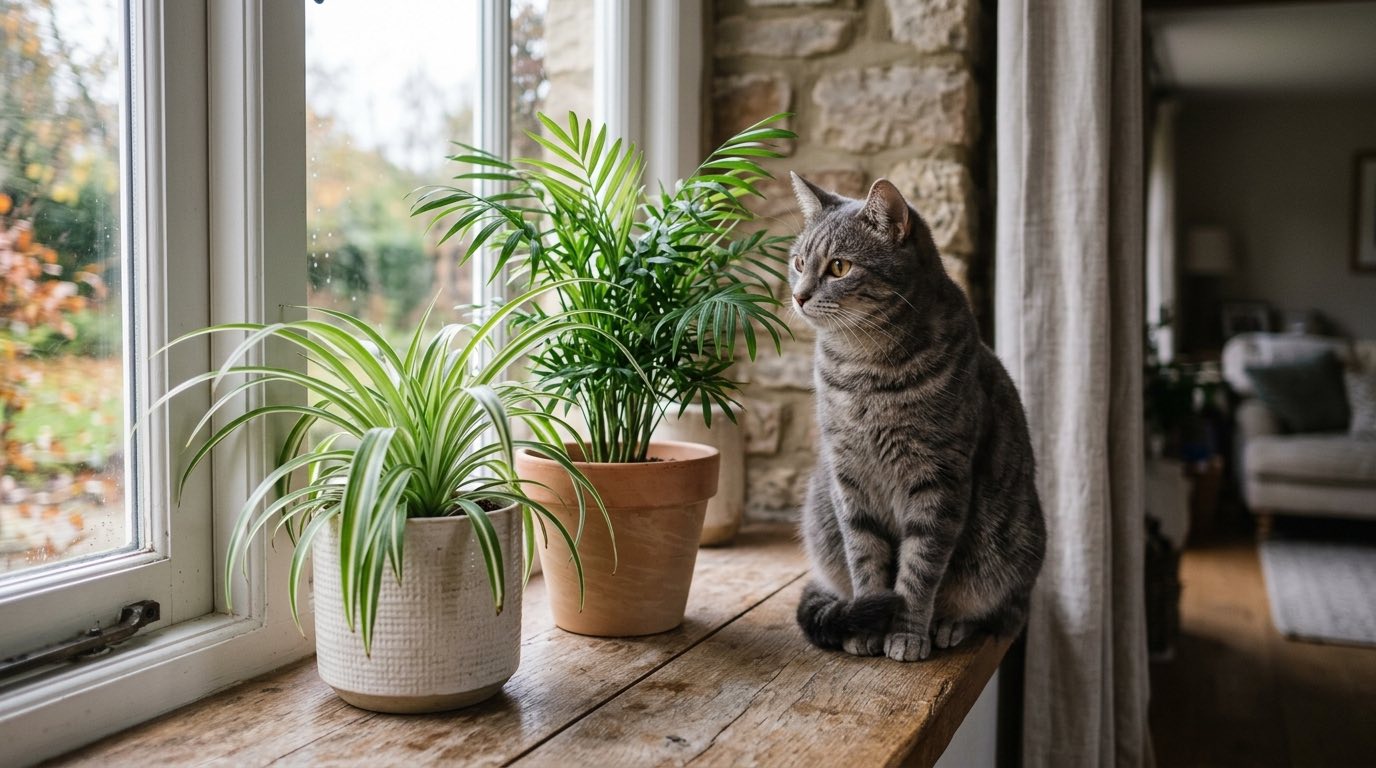
TL;DR: There are three answers to "is this plant safe for my cat", not two. Of the 100 common houseplants we checked against the ASPCA lists, 28 are named non-toxic, 33 are named toxic, and 39 are not named at all. That last group is the interesting one, because most pet-safe plant lists quietly count it as safe. Snake plant and aloe are on the toxic list. Calathea, prayer plant and ZZ plant are on neither.
Search for pet-safe houseplants and every result gives you a confident green tick or a red cross. The confidence is mostly manufactured. The underlying source almost everyone uses is the ASPCA's toxic and non-toxic plant lists, and those lists do not cover every plant sold in a garden centre. When a species is missing, a green tick is not a finding. It is a blank being filled in.
Not listed is not the same as safe #
The ASPCA maintains two public lists: plants they have entries for as toxic, and plants they have entries for as non-toxic. Anything on neither list has not been ruled safe. It has not been examined.
Run 100 common houseplants against both lists and the split comes out like this:
| Verdict | Count | What it means |
|---|---|---|
| Listed non-toxic | 28 | The ASPCA names this exact species on the non-toxic list |
| Listed toxic | 33 | The ASPCA names this exact species on the toxic list |
| Not settled | 39 | Neither list names it |
Nearly two in five of the plants people actually buy fall into that third column. A site that shows you a two-state answer has decided what to do with those 39, and the decision is almost always to call them safe, because "we don't know" is a bad look next to a competitor's green tick.
There is a second trap underneath it. Toxicity is not reliably a family trait. Some genera are consistent and some are not, so reading a verdict across from a relative is a guess dressed up as research. Euphorbia trigona, the African milk tree, is a good example: the ASPCA lists a close relative, the pencil cactus, as toxic, and does not list the African milk tree at all. Reasonable grounds for caution, not grounds for a verdict.
The 28 that are actually listed non-toxic #
These are the species the ASPCA names on its non-toxic list, with the light each one wants, because a pet-safe plant that dies in your hallway has not solved anything.
| Plant | Light it prefers | Effort |
|---|---|---|
| Spider plant | Medium to bright indirect | Low |
| Parlour palm | Low to medium | Low |
| Lady palm | Low to medium | Low |
| Cast iron plant | Low | Low |
| Kentia palm | Medium to bright indirect | Low |
| Areca palm | Bright indirect | Medium |
| Ponytail palm | Bright indirect to direct | Low |
| Boston fern | Medium | High |
| Button fern | Low to medium | Medium |
| Rabbit's foot fern | Medium | Medium |
| Staghorn fern | Medium to bright indirect | Medium |
| Money tree | Bright indirect | Low |
| Baby rubber plant | Medium to bright indirect | Low |
| Watermelon peperomia | Bright indirect | Low |
| African violet | Bright indirect | Medium |
| Wax plant (hoya) | Bright indirect | Low |
| Nerve plant | Medium to bright indirect | High |
| Polka dot plant | Bright indirect | Medium |
| Zebra plant | Bright indirect | High |
| Norfolk Island pine | Bright indirect | Medium |
| Scarlet star | Bright indirect | Low |
| Burro's tail | Direct sun | Low |
| Ghost plant | Direct sun | Low |
| Mexican snowball | Direct sun | Low |
| Dwarf banana | Bright indirect to direct | High |
| Basil | Direct sun | High |
| Rosemary | Direct sun | Medium |
| Thyme | Direct sun | Medium |
If your room is dim, the useful part of that table is short: cast iron plant, parlour palm, lady palm, button fern. Those four are non-toxic and genuinely accept low light. Most of the rest want a window.
The ones people get wrong #
Snake plant is on the toxic list. It appears on pet-friendly round-ups constantly, presumably because it is famously hard to kill and that gets confused with harmless. The ASPCA lists it as toxic to cats and dogs.
Aloe vera is on the toxic list. A plant kept for treating burns is not a plant to leave where a cat chews things.
Pothos, monstera, heartleaf philodendron, arrowhead plant and peace lily are all toxic, and they are five of the most-sold houseplants there are. They share a mechanism: insoluble calcium oxalate crystals, which cause mouth irritation, drooling and difficulty swallowing when chewed. Rarely fatal, and genuinely miserable for the animal.
Sago palm is the one to take seriously. It is on the toxic list, and unlike the oxalate group, vets treat ingestion of any part of it as an emergency rather than something to monitor at home. If you have one and a pet that chews, the honest answer is to rehome the plant rather than to place it cleverly.
And then the ones nobody has settled. These all get recommended as pet-safe somewhere, and the ASPCA lists name none of them:
- ZZ plant
- Calathea, peacock plant, prayer plant, stromanthe and never never plant, the whole prayer-plant group
- Chinese money plant (pilea)
- Moth orchid
- Christmas cactus
- Bird's nest fern
- Zebra haworthia
- String of pearls and string of hearts
- Inch plant and purple heart
Some of those may well turn out to be harmless. The point is that nobody has published a verdict, and a page that gives you one is inventing it.
Non-toxic does not mean nothing happens #
The ASPCA is clear that its own list is not all-inclusive, and that eating plant material can cause vomiting and stomach upset whatever the listing says. A cat that eats half a spider plant is going to have a bad evening even though the spider plant is on the non-toxic list.
Non-toxic means the species is not known to cause poisoning. It does not mean a plant is food.
The question is not only "is it safe" #
Pet safety on its own gives you a shopping list that ignores your flat. A plant that is safe for your cat and needs bright indirect light, sitting on a shelf that gets 1,800 lux, is going to stretch, pale and slowly give up. You will have solved for the cat and not for the plant.
The two constraints have to be applied at once: what will live where the pot is going, and which of those the ASPCA has actually cleared.
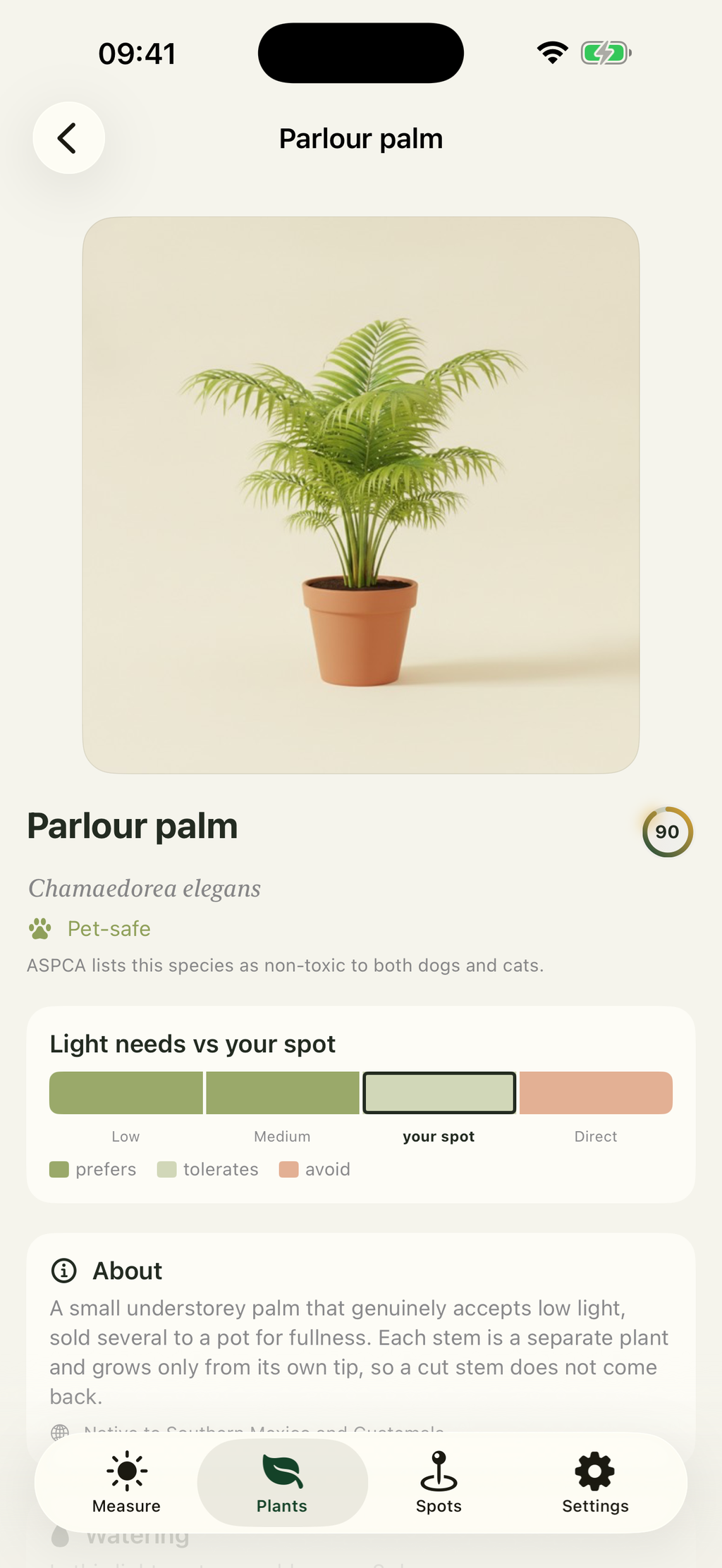
Solspot does both. It reads the light sensor behind your phone's front camera, reports the spot in lux with the range that figure could honestly sit in, then matches it against the same 100 species. Turning on the pet-safe filter narrows the results to the 28 that the ASPCA names as non-toxic, and it excludes the unverified ones rather than waving them through, which is the whole reason the filter is worth having.
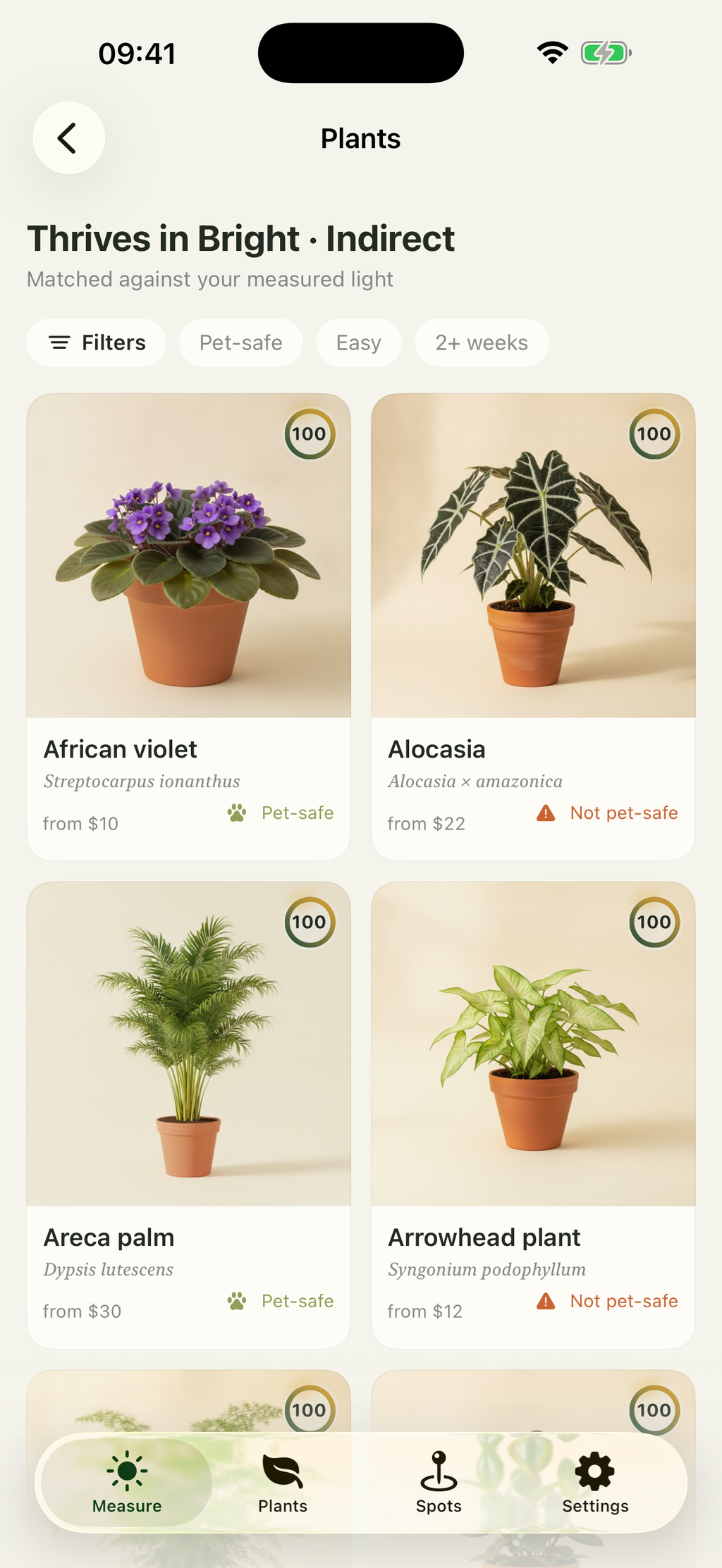
Each species page names the source of its verdict rather than showing a bare icon, so you can see whether a listing covers that exact species or something adjacent to it.

If you would rather not install anything, the pet-safe plant checker runs the same 100 species in a browser, with the three-way verdict and a link to the ASPCA entry behind each one.
Practical rules that survive contact with an actual cat #
Height is not a plan. Cats go up. A shelf is a destination, not a barrier.
Dogs mostly dig, cats mostly chew. The risk from a dog is often the soil, the fertiliser pellets and the drainage stones as much as the leaves.
Fallen leaves count. A toxic plant sheds onto the floor, which is exactly where a pet finds it. Sweeping under the plant matters as much as where the plant sits.
Cut flowers deserve their own check. Lilies are the serious one for cats, and a bouquet is far more likely to end up somewhere reachable than a potted plant is.
If something gets eaten, ring a vet. The ASPCA Animal Poison Control Center runs a 24 hour line on (888) 426-4436, and a consultation fee may apply. Bring a piece of the plant or a photo. This page is for choosing plants, not for handling an emergency.
The short version #
Two of the plants most often recommended as pet-safe, snake plant and aloe, are on the toxic list. Several of the others, including calathea and ZZ plant, are on no list at all. Of 100 common houseplants, only 28 have actually been cleared.
Pick from those 28, check what light your spot gives before you buy, and treat a confident green tick from a site that has not told you where it came from as the guess it usually is.
Solspot is free on iPhone and iPad, runs fully offline, and has no account and nothing to buy inside it.
Sources and attribution #
Every verdict on this page states, in our own words, whether the ASPCA toxic and non-toxic plant lists name a given species. No ASPCA text, description or image is reproduced here, and the pet-safe plant checker links each species to the ASPCA page it was checked against so you can read their entry there.
ASPCA® is a registered trademark of the American Society for the Prevention of Cruelty to Animals, used here only to identify the source of the verdicts. The ASPCA is not affiliated with Applestan or with this page, has not reviewed it, and does not endorse it. The ASPCA notes that its own list is not all-inclusive, and that eating any plant material can cause vomiting and stomach upset whatever the listing says.
Light requirements come from the North Carolina Extension Gardener Plant Toolbox and Missouri Botanical Garden, cited per species on the plant light requirements tool.