TL;DR: Bright indirect light is roughly 10,000 to 20,000 lux. It is the light right at an unobstructed window with no sun falling on the leaves. It is much rarer indoors than the phrase suggests, and the spot most people call bright indirect is usually medium light, around 2,500 to 10,000 lux. That mismatch is why a plant that is supposedly in the right place still stretches, pales, and slowly gives up.
A well-lit office is around 500 lux. An overcast day outdoors is about 10,000. Direct summer sun is above 100,000. Those are not close together, and your eyes will happily call all three of them "bright", because human vision adapts across the whole range and a leaf does not.
That gap is the whole problem. A spot can look bright to you and read as low light to a plant, and nothing about standing in the room will tell you which one you have.
The phrase does not mean anything on its own
"Bright indirect light" is on almost every plant tag sold. It is not defined by anyone. There is no standards body for plant labels, so a grower raising a plant under greenhouse glass and a garden centre printing shelf tags can both use the phrase while describing conditions that are nothing like each other.
That leaves you translating a phrase into a place in your home, using nothing but a guess. And the guess has a consistent bias: people put plants where the plants look good, then describe that spot in the most flattering terms the tag allows.
The actual numbers
Light is measured in lux. One lux is one lumen per square metre, and the useful thing about it is that it is a property of a place, not of a plant. You can measure the spot before you buy anything to put in it.
| Category | Lux | What it looks like |
|---|---|---|
| Low | Under 2,500 | Most rooms away from a window, and most rooms lit by lamps |
| Medium | 2,500 to 10,000 | A few steps back from good glass, or a bright room on an overcast day |
| Bright indirect | 10,000 to 20,000 | Right at unobstructed glass, with no sun landing on the leaves |
| Direct | Above 20,000 | Sun falling on the spot itself |
For scale, a well-lit office is around 500 lux. An overcast day outdoors is about 10,000. Direct summer sun outside is above 100,000. Indoors is far darker than it feels, because your eyes adjust and a camera meter does not.
That last point is the one worth sitting with. Human vision is adaptive across an enormous range. A room reads as "bright" to you at 800 lux and also at 15,000 lux. Your plant experiences those as completely different places.
Why the spot you picked is probably medium
Bright indirect light needs two things at once: a lot of light, and none of it arriving as direct sun. Indoors, those two conditions fight each other.
Get far enough from the window that the sun never touches the leaves and you have usually also dropped into medium light. Stay close enough to the glass to hold 10,000 lux and, in most rooms with a south or west aspect, the sun will land on that spot for part of the day.
The places that genuinely deliver bright indirect are more specific than the phrase implies:
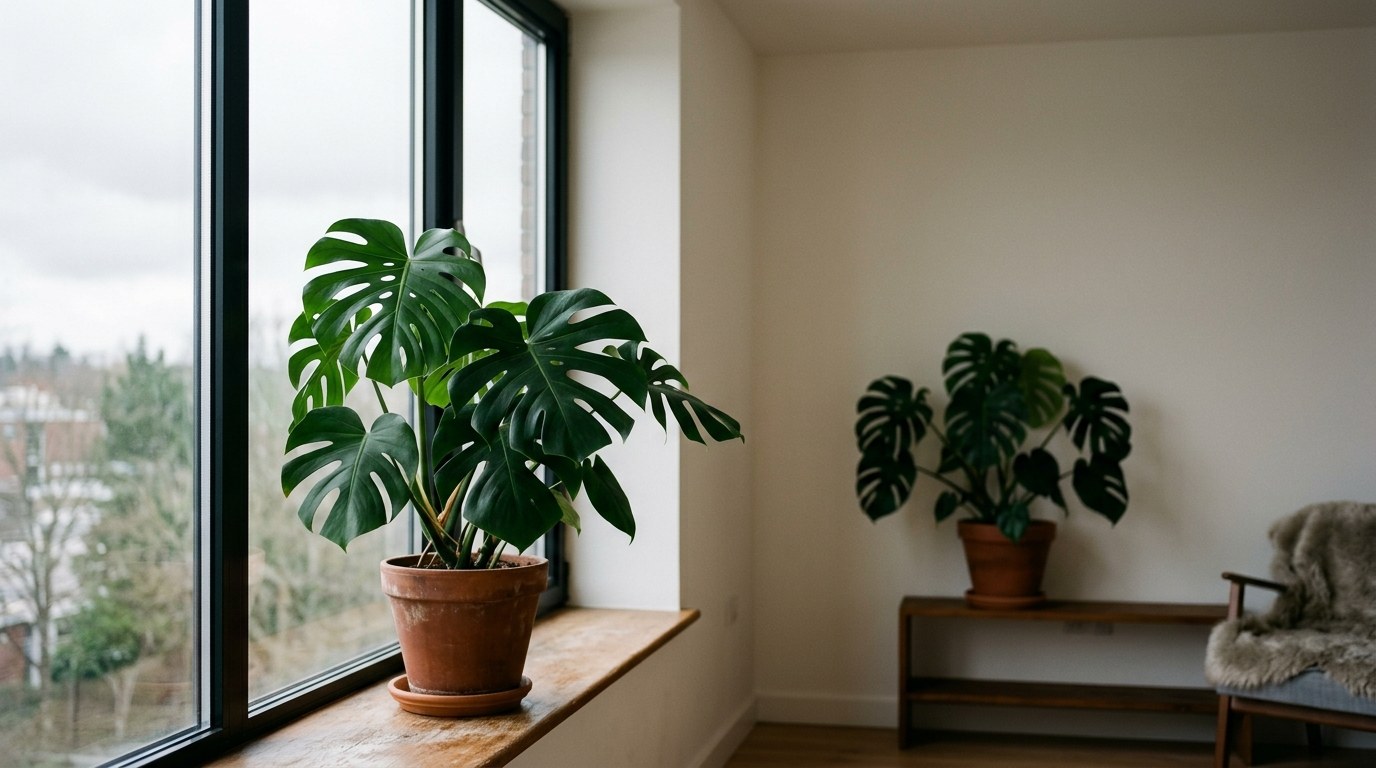
- Right at a large east-facing window, where the morning sun is weak and the rest of the day is bright but indirect
- At a south or west window with a sheer curtain diffusing the direct beam
- Directly beside, rather than in front of, a bright window, catching the light without the beam
- At a large north-facing window on a bright day, though this sits at the low end
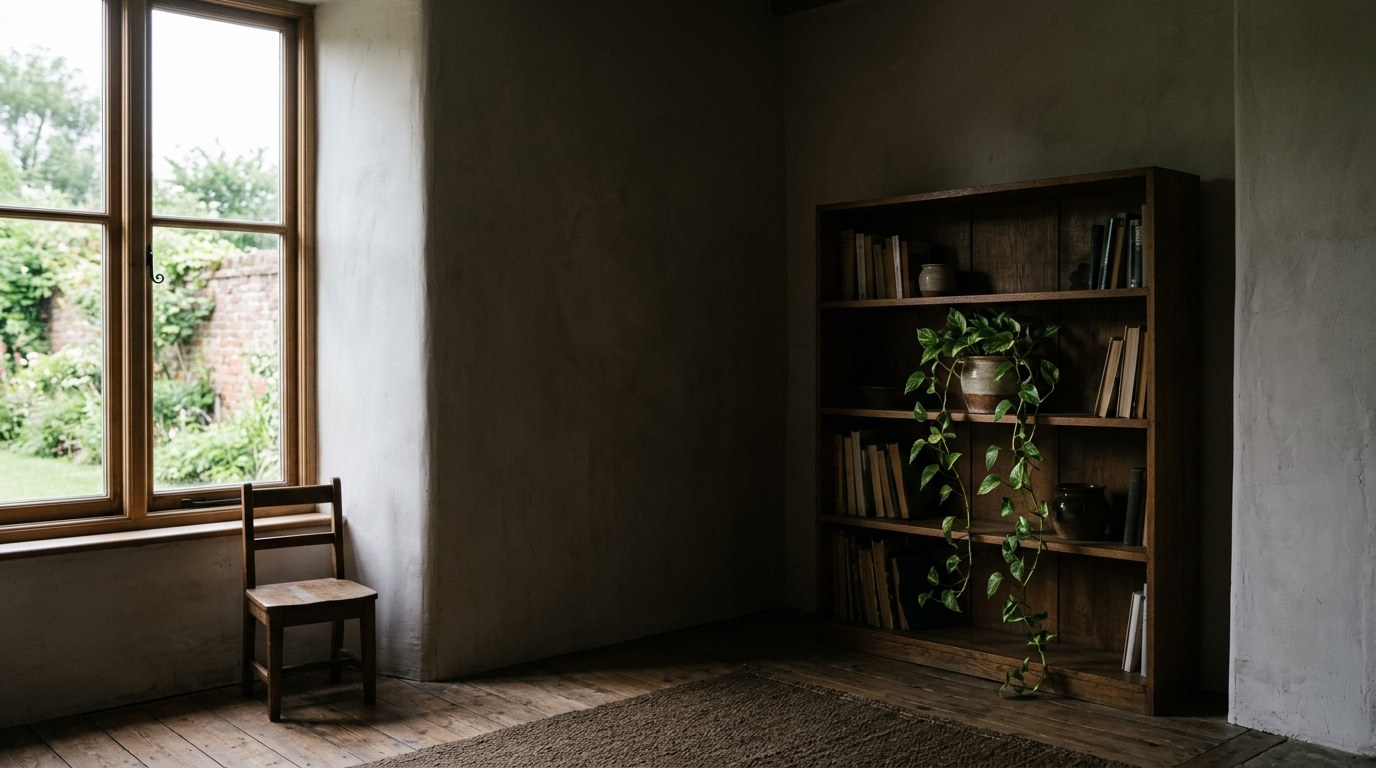
A shelf across the room from a bright window is not bright indirect light. It is a medium spot, and quite often a low one. Light falls off fast with distance. Moving a plant from the windowsill to a metre back into the room can cut what it receives by more than half.
Checking without buying a meter
The shadow test is the traditional method and it is better than nothing. At midday, hold your hand about a foot above the surface where the pot would sit:
- Hard shadow with sharp edges. Direct sun.
- Soft shadow with a clear outline. Somewhere around bright indirect.
- Faint, fuzzy shadow. Medium.
- No real shadow. Low.
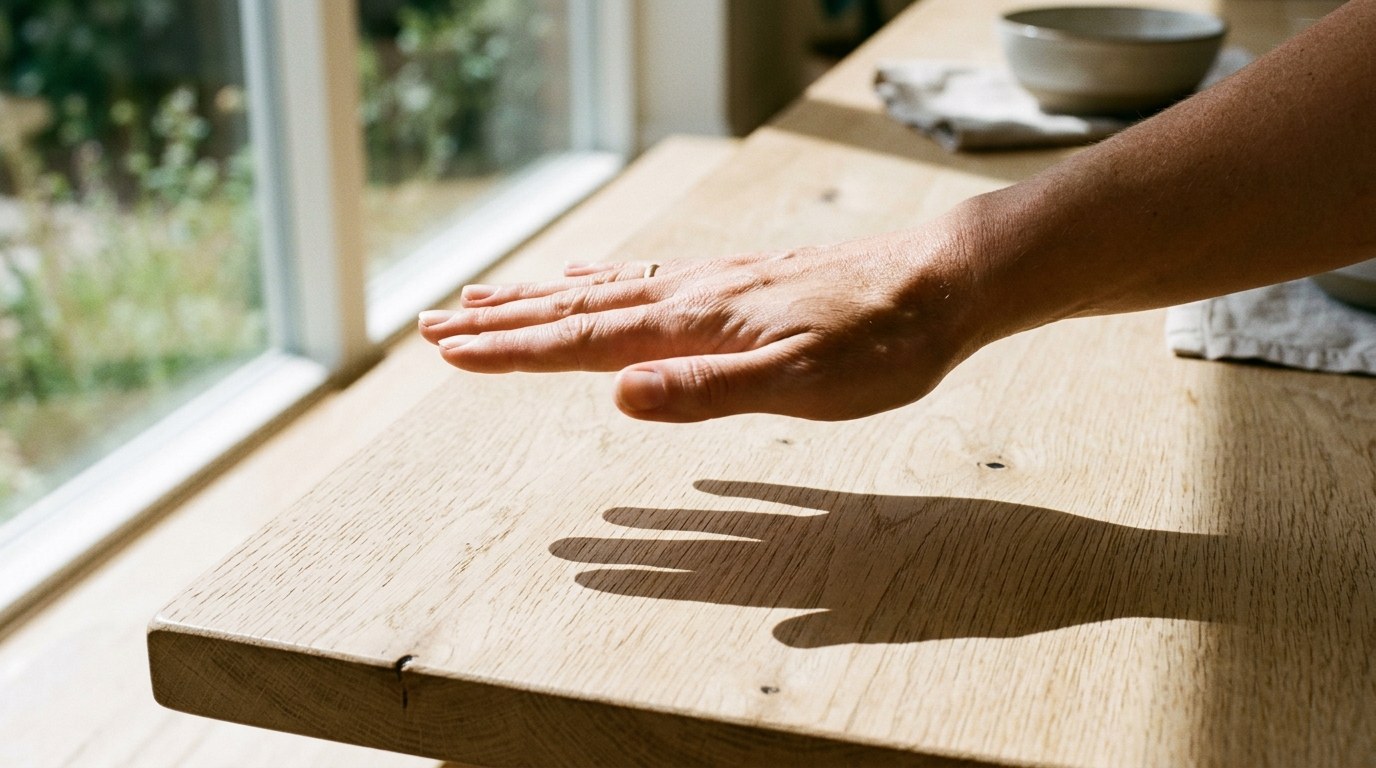
It works, roughly, and it costs nothing. Its limits are that it needs a clear day, it collapses four categories into four fairly coarse buckets, and it tells you about this exact moment rather than about the spot in general.
The other option is a dedicated lux meter, which is accurate and costs money for a device you will use four times a year.
The third is a phone. Your phone already has a calibrated light sensor behind the front camera, which is what adjusts your screen brightness. That sensor can be read as a lux value.
This is the part Solspot does. Lay the phone flat where the pot will stand, screen facing the light, and it reads the exposure meter and reports the level in lux, the category it falls into, and the range that number could honestly sit in. No photo is taken and the app has no viewfinder, because it is measuring the light arriving at a surface, the way a leaf receives it, rather than photographing anything.
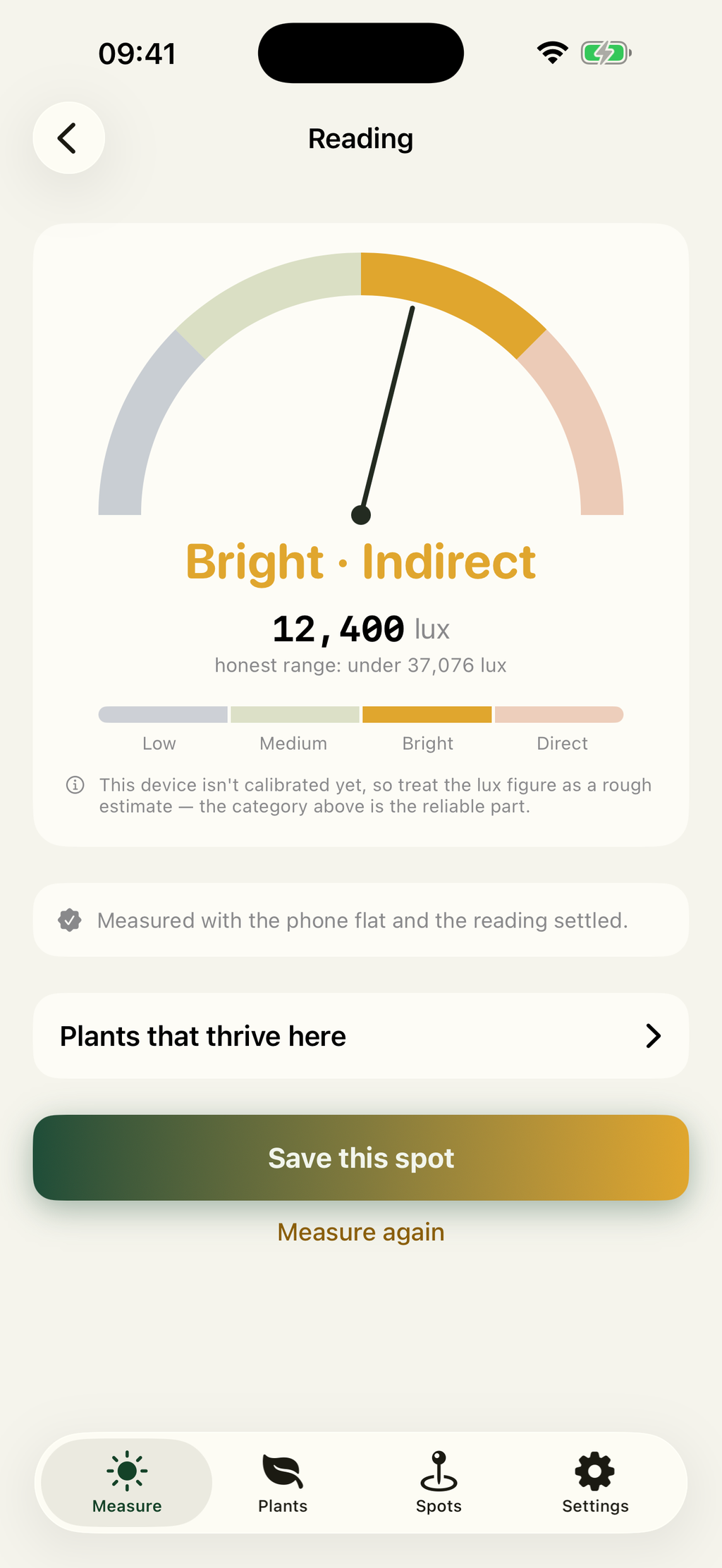

Where phone measurement is weak, and where it is fine
A phone is not a laboratory instrument, and anyone selling you one as if it were is overstating it.
The sensor sits behind glass that may be smudged, its response is tuned for adjusting a screen rather than for photometry, and Apple does not publish per-device calibration. Two phones in the same spot can differ. That is why Solspot attaches a range to every reading and widens that range when the device has not been calibrated, instead of printing a single confident number.
Where it is weak: absolute precision. If you need a defensible figure for a grow operation, buy a real meter.
Where it is fine, and where most people actually are: comparing two spots in your own home, sorting a place into one of four categories, and checking whether the shelf you had in mind is anywhere near what a plant needs. Those questions survive a margin of error of a few thousand lux. "Is this windowsill brighter than that bookshelf" is answerable by any consistent sensor, even an imperfectly calibrated one, because the same error applies to both readings.
Other apps in this space exist and some are good. Photone is the one to look at if you want PPFD and DLI for growing rather than for houseplants, and it goes deeper on that than Solspot does. If you want to identify a plant from a photo, PictureThis does that and Solspot does not do it at all. Solspot only answers one question: how much light is here, and what will live in it.
The measurement is not the point
Knowing a spot reads 6,000 lux is only useful next to a plant's actual requirement, and requirements come as three separate numbers that tags flatten into one phrase:
- The light a plant prefers, where it grows well
- The light it tolerates, where it survives without thriving
- The light it cannot survive, where it declines no matter what else you do
A pothos prefers medium, tolerates low, and is genuinely hard to kill on light alone. A fiddle leaf fig wants the bright indirect end and sulks anywhere below it. Both get sold with similar-sounding tags.
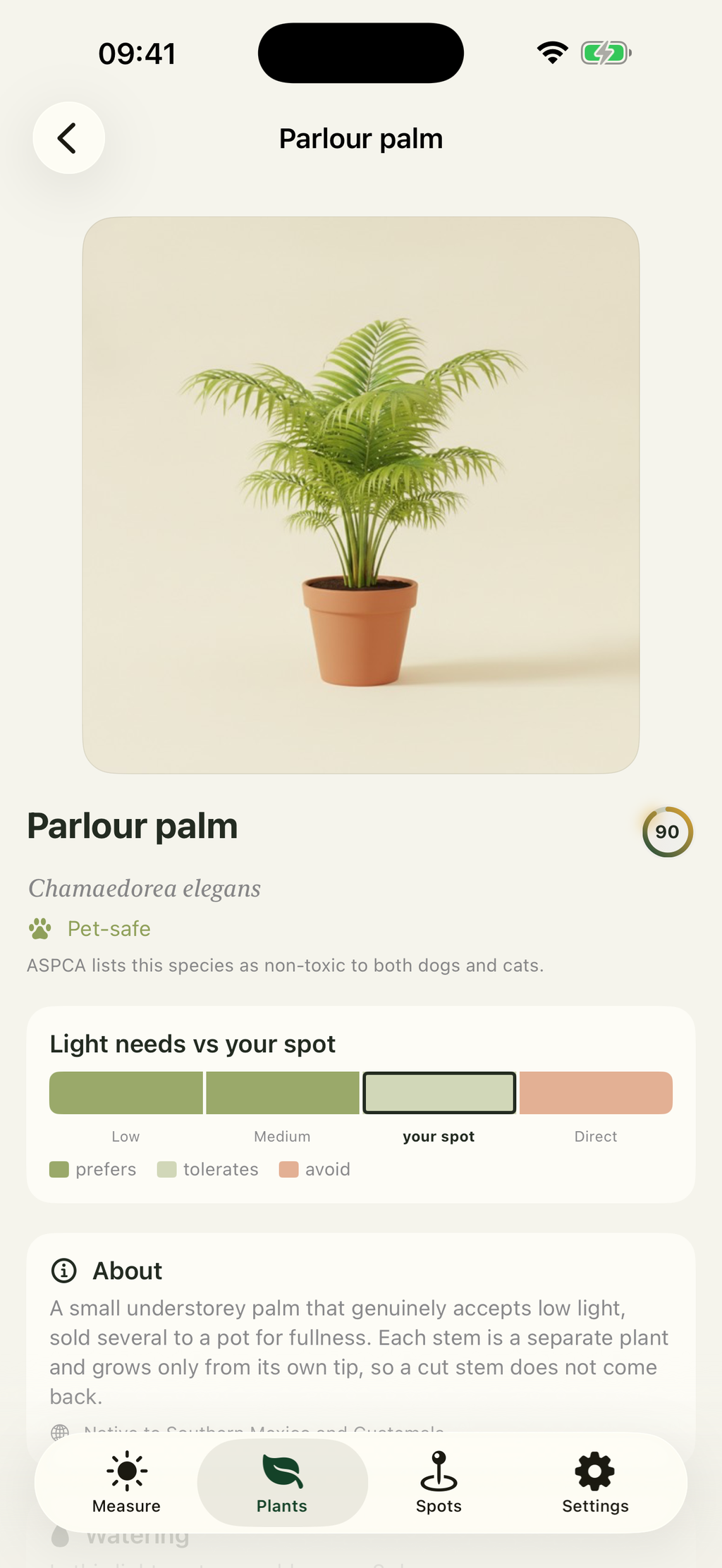
Solspot matches a measured reading against 100 species on those three bands, so the answer comes back as a list of what will actually live in the spot you measured rather than as a number you then have to research. It also carries pet toxicity from the ASPCA's toxic and non-toxic plant lists, and marks a species as unverified when those lists do not name it, rather than guessing on a question where guessing is not acceptable.
Measure again in December
A windowsill in June and the same windowsill in December are different places. The sun is lower, the days are shorter, and cloud cover is heavier. A spot that read comfortably bright indirect in summer can be medium or low by midwinter, which is exactly when people notice a plant looking unhappy and start changing the watering instead.
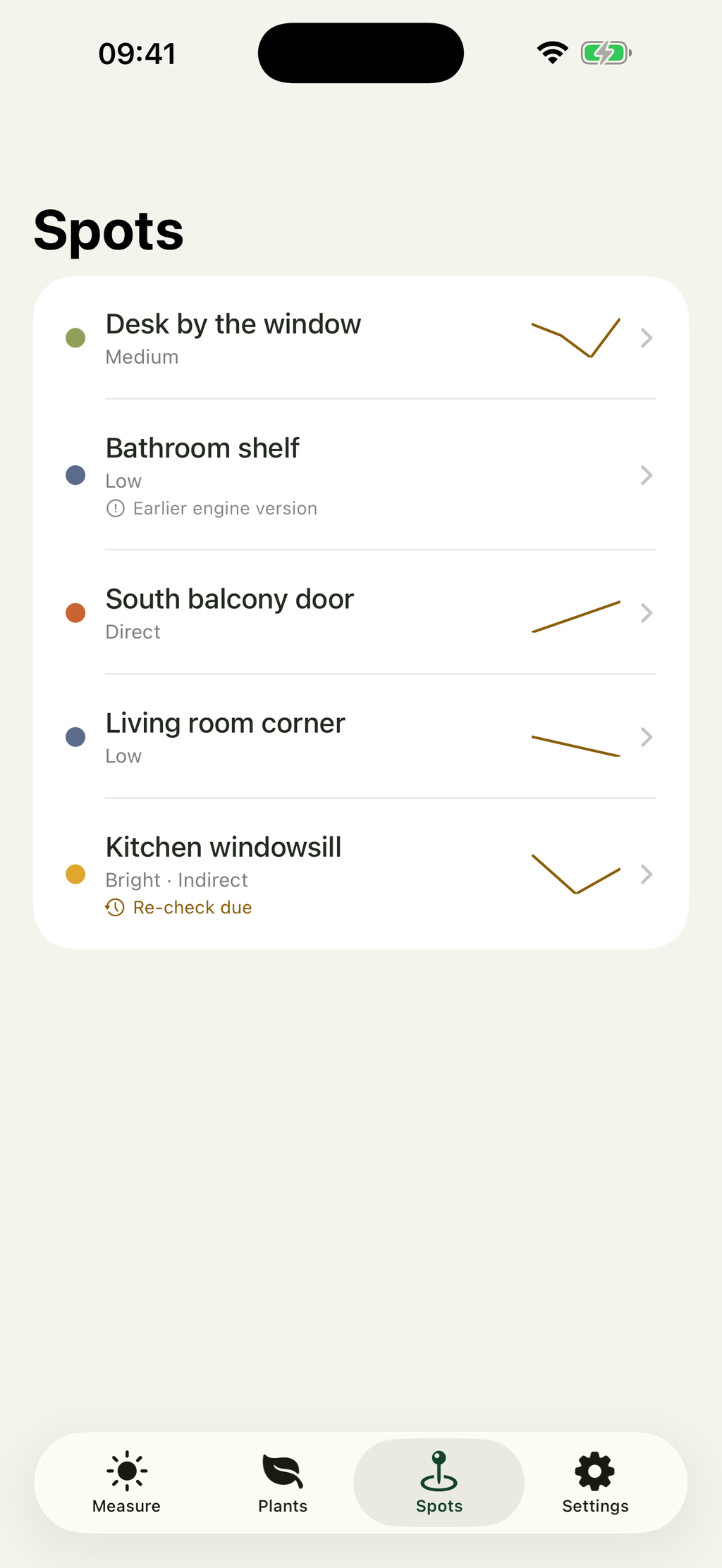
Saving a spot and re-measuring it seasonally costs a few seconds and explains a lot of slow declines that get blamed on something else.
The short version
Bright indirect light is 10,000 to 20,000 lux, it is rarer indoors than the phrase makes it sound, and most spots people describe that way are medium light. You do not have to take anyone's word for which one you have. Measure it, then pick a plant that suits the answer, rather than picking a plant and hoping the spot cooperates.
Solspot is free on iPhone and iPad, works fully offline, and has no account and nothing to buy inside it.