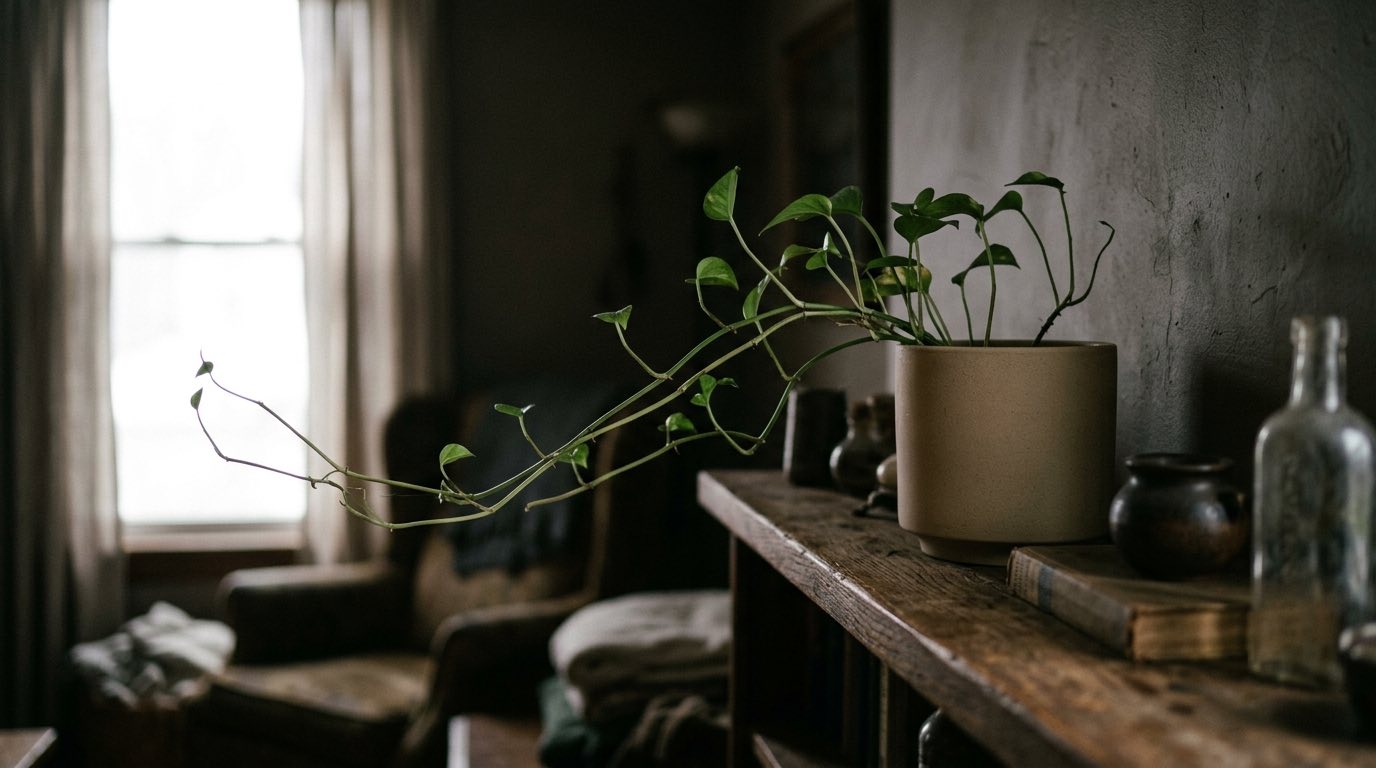
TL;DR: Too little light shows up as smaller new leaves, longer gaps between leaves, leaning, fading variegation, growth that stops, and soil that stays wet for far too long. None of it happens fast, which is why it usually gets treated as a watering problem. The fix is to move the plant closer to the glass, not to change the watering, and the way to know is to measure the spot rather than judge it by eye.
A plant that is short of water tells you within a day. It wilts, you water it, it recovers, and the feedback loop teaches you something.
A plant that is short of light tells you over two months, in symptoms that all look like something else. By the time it is obvious, the change that caused it is long forgotten, and the usual response is to water it more, which makes a dim, slow-drying pot worse rather than better.
The signs, roughly in the order they turn up #
New leaves come in smaller than the old ones #
This is the earliest reliable sign and almost nobody notices it, because a smaller leaf is still a new leaf and new growth reads as good news.
A leaf is expensive to build. In dim conditions a plant makes cheaper ones: smaller, thinner, sometimes a darker green because it is packing in more chlorophyll to catch what little there is. Hold a leaf that opened this month next to one from last year. If the new one is visibly smaller and the plant has not been repotted or gone hungry, light is the first thing to suspect.
The gaps between leaves get longer #
The technical name is etiolation. The plant stops investing in leaves and starts investing in reach, so the stem lengthens between each leaf node and the whole thing looks stringy.
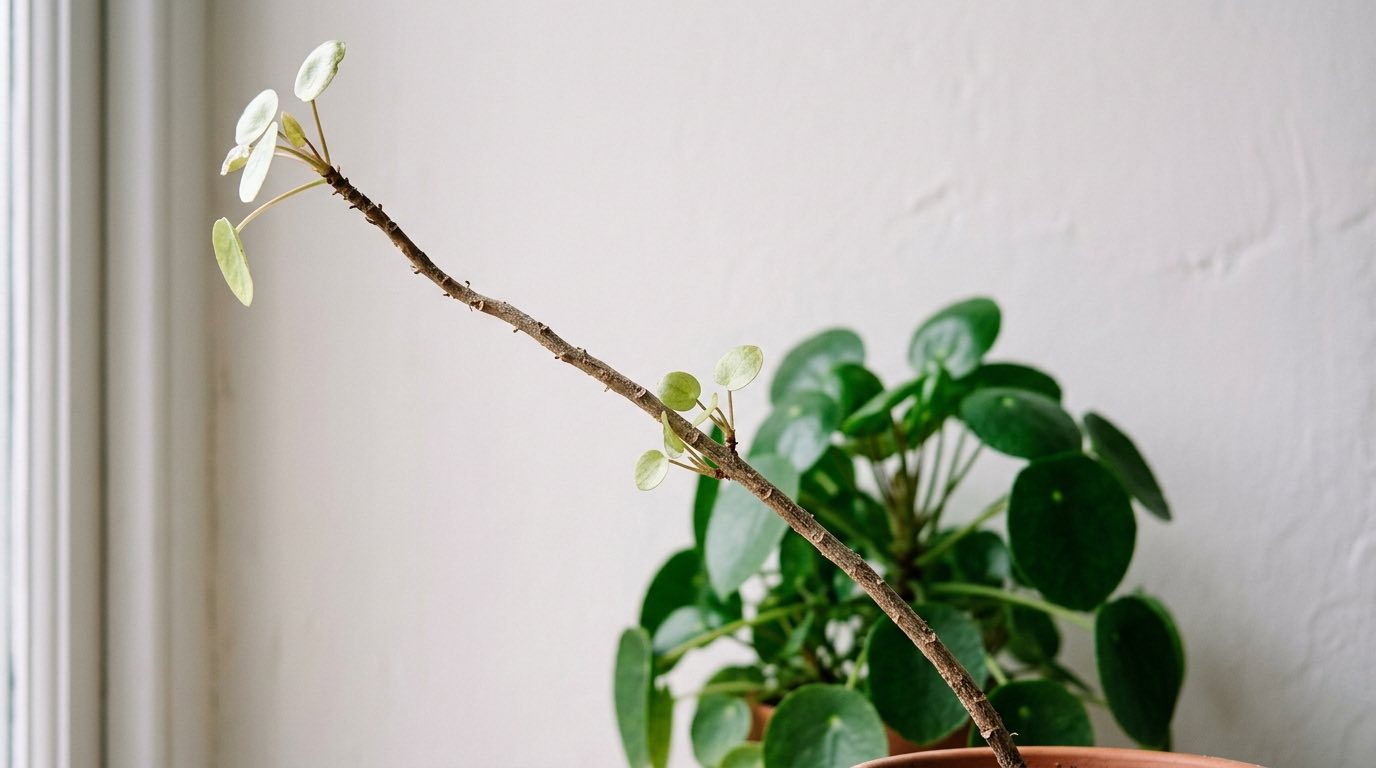
This is the sign worth knowing best, for two reasons. It is unambiguous, since nothing else produces long bare internodes. And it does not undo itself. Move the plant into good light and the new growth comes back compact, but the stretched section stays stretched for the life of that stem.
Everything leans the same way #
A plant leaning toward the window is doing the same thing as the stretching, in a direction. On its own it is normal and a quarter turn every couple of weeks handles it.
It matters when the lean is severe, when it comes back within days of turning the pot, or when it comes with the leaves on the dark side dropping. At that point the plant is not evening itself out, it is telling you the difference between the bright side and the dark side of the same pot is large.
Variegation fades to plain green #
Variegated leaves are partly white or cream, and those parts have no chlorophyll and do no work. In good light a plant can afford that. In poor light it cannot, so the new leaves come in solid green.
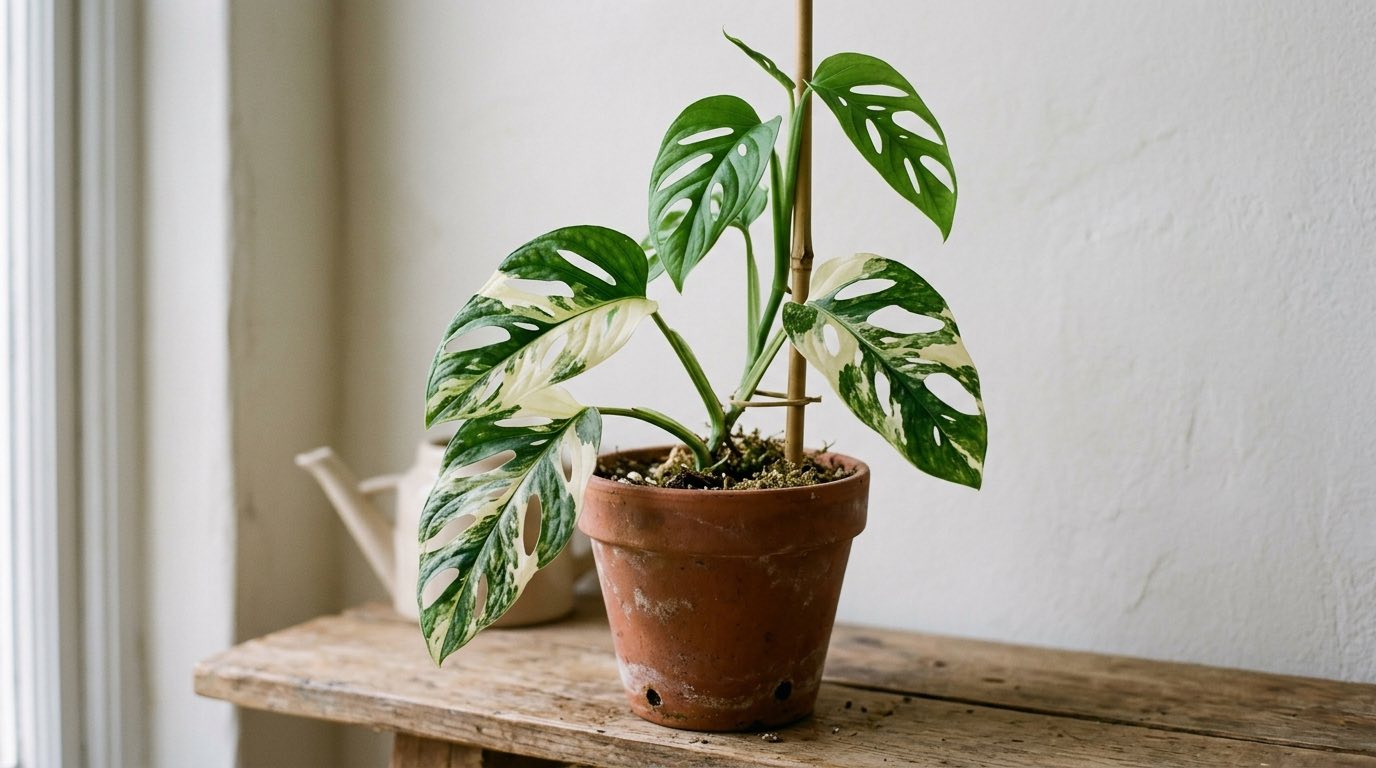
You cannot argue a leaf back into being variegated. If the pattern is why you bought the plant, treat green new growth as a deadline rather than a curiosity.
Growth simply stops #
Not death, not decline, just nothing. Same leaves, same size, same everything, month after month.
This is the hardest one to spot because there is nothing to see. A plant with enough light to hold its leaves but not enough to grow can sit in that state for a very long time and look fine in a photo. Take a photo. Compare it to one from three months ago. That comparison is more honest than memory.
Some pause is normal in midwinter for almost everything, so a stall from November to February is not evidence on its own. A stall through spring is.
The soil stays wet much longer than it used to #
This is the sign that gets misread most often, and it is the one that does the actual killing.
Light drives photosynthesis, photosynthesis drives water use, and a plant in dim light uses far less water than the same plant at a window. So the pot stays heavy for a week and a half instead of five days. Nothing about the plant looks different, so the watering schedule stays the same, and now the roots are sitting wet.
What follows is root rot, and root rot presents as yellowing lower leaves and a plant that looks thirsty while standing in wet soil. That gets treated as underwatering. It is the last step of a light problem wearing a watering problem's clothes.
If a pot has started drying more slowly than it used to and you have not repotted it, that is a light signal before it is a water signal.
The lower leaves drop #
Older leaves at the base going yellow and falling, while the top of the plant carries on, is a plant cutting costs. Those leaves are shaded by everything above them and are no longer paying for themselves, so it withdraws what it can and drops them.
A leaf or two over a season is ordinary ageing. A steady march up the stem, leaving bare trunk behind, is not.
It never flowers #
Flowering is the first thing a plant gives up. Peace lilies, African violets, hoyas, orchids and Christmas cacti will all sit in low light being perfectly green and perfectly leafy for years without ever blooming.
If a plant is healthy but has never flowered for you, more light is the answer far more often than fertiliser is.
Signs that are usually not about light #
Half of getting this right is not chasing light for problems that have another cause.
| What you see | Usually means |
|---|---|
| Yellow lower leaves, soil wet | Overwatering or root rot, which low light contributes to |
| Crisp brown leaf edges and tips | Dry air, underwatering, or salt build-up from tap water and fertiliser |
| Pale stippled leaves, fine webbing | Spider mites. Look under the leaves |
| Sudden collapse over a few days | Roots, or a cold draught, not light |
| Bleached pale patches on the sunny side | Too much light, the opposite problem |
| Small brown spots with yellow halos | Fungal or bacterial, usually with poor airflow |
The pattern worth remembering: light problems are slow and affect new growth first. Water and root problems are faster and affect old growth first.
Why this is so easy to get wrong #
Your eyes are the problem. Human vision adapts across an enormous range, so a room reads as "bright" at 800 lux and also at 15,000. Your plant experiences those as different worlds.
Light also falls away much faster than it feels like it should. Moving a pot from the windowsill to a shelf a metre into the room can cut what it receives by more than half, and the room still looks the same to you when you walk in.
So the sentence "it's in a bright room" describes your experience of the room and tells you almost nothing about the pot.
Check the spot, not the plant #
The reliable move is to measure where the pot actually stands.
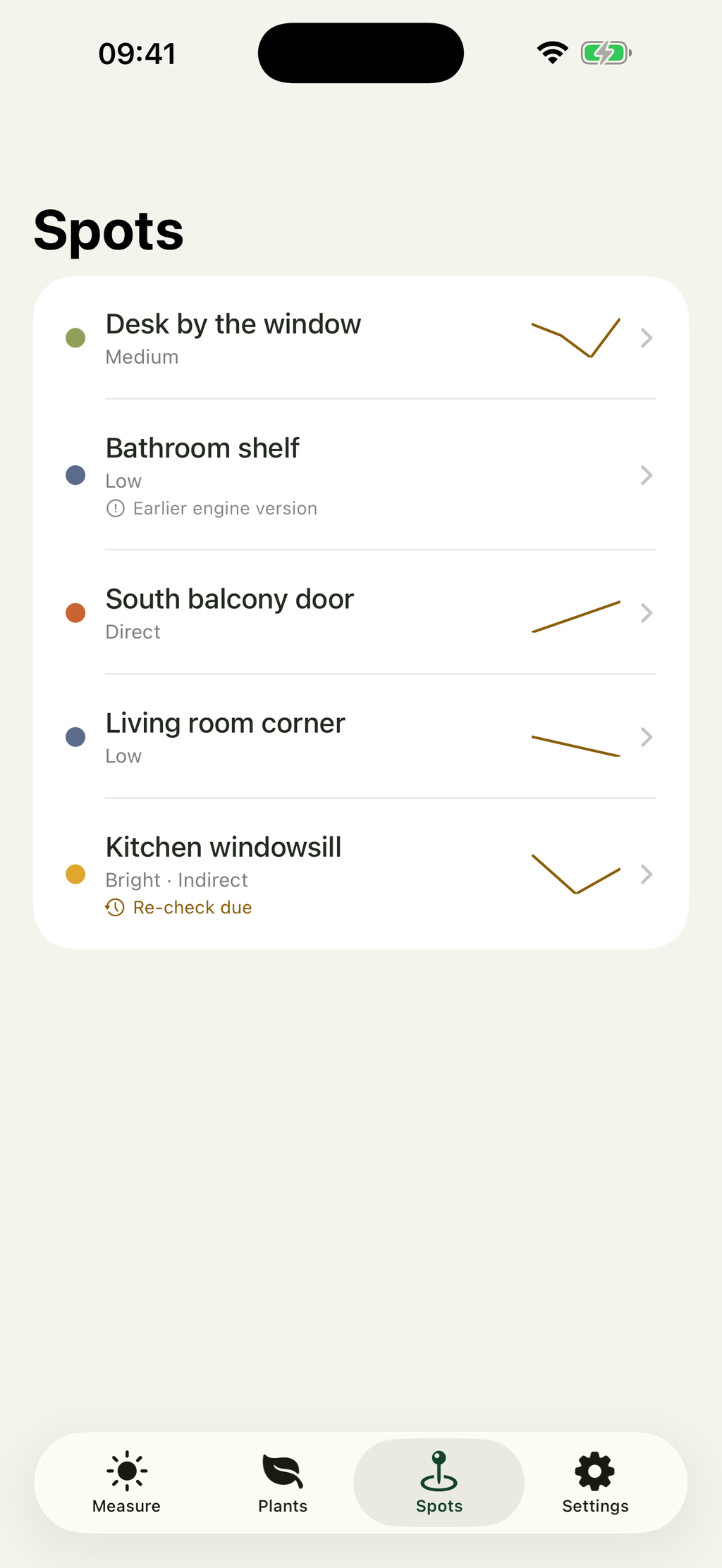
Solspot reads the light sensor behind your phone's front camera, which is the one that adjusts your screen brightness. Lay the phone flat where the pot sits, screen facing the light, and it reports the level in lux, the category that falls into, and the range the number could honestly sit in. No photo is taken, because it is measuring the light arriving at a surface rather than photographing anything.
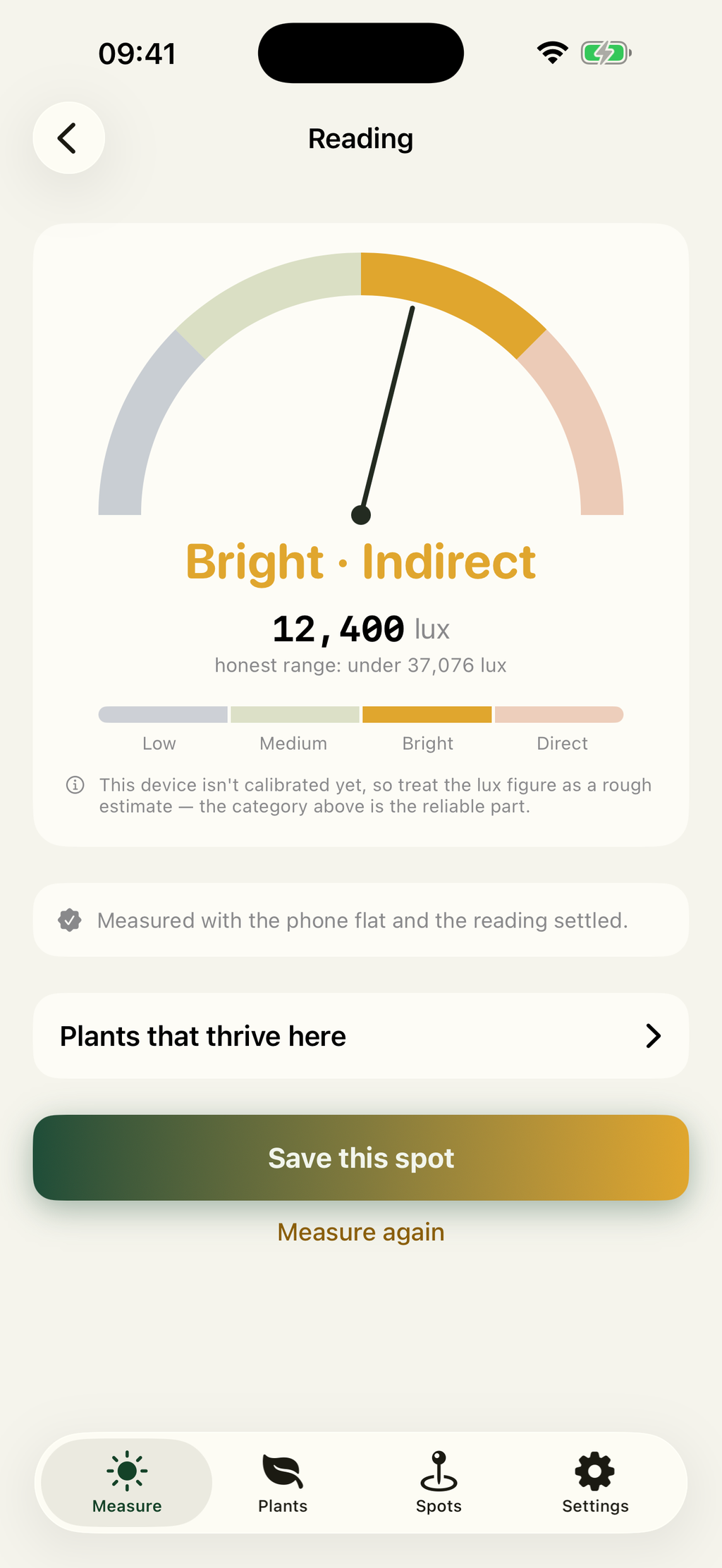

The categories:
| Category | Lux | What lives there |
|---|---|---|
| Low | Under 2,500 | Cast iron plant, parlour palm, lady palm, ZZ plant |
| Medium | 2,500 to 10,000 | Pothos, spider plant, snake plant, dracaenas, most ferns |
| Bright indirect | 10,000 to 20,000 | Monstera, fiddle-leaf fig, hoya, most variegated plants |
| Direct | Above 20,000 | Succulents, cacti, herbs, jade |
A phone sensor is not a laboratory instrument. It sits behind glass that may be smudged, it is tuned for adjusting a screen rather than for photometry, and two devices can disagree. Solspot attaches a range to every reading for that reason and widens it when the device has not been calibrated.
That imprecision does not matter for this question. "Is the shelf dimmer than the windowsill, and by how much" is answerable by any consistent sensor, because the same error applies to both readings. Absolute precision would matter if you were running a grow operation, and if that is you, buy a real meter or look at Photone, which goes considerably deeper on PPFD and DLI than Solspot does.
If you would rather not install anything, the window light estimator makes a rough guess from your window's direction, what is outside it and how far back the pot sits, and the plant light requirements tool lists what 100 species prefer, tolerate and cannot survive.
What to do once you know #
Move it closer to the glass, not just to a brighter room. Distance from the window is the single biggest lever you have indoors, and it is free. A metre closer often does more than any other change.
Do not fertilise a plant that is short of light. Fertiliser feeds growth the plant cannot currently afford to make. It builds up in the soil instead, which is one of the causes of those crisp brown edges.
Cut back the leggy growth, once the light is fixed. New compact growth will not fill in the bare stretch on its own. Check the species first: a parlour palm grows only from the tip of each stem, so a cut stem does not come back, while a pothos will resprout happily.
Re-measure the same spot in December. A windowsill in June and the same windowsill in January are different places, and the January reading is usually the surprising one. Saving a spot and re-checking it seasonally explains a lot of the declines that start in November.
Match the plant to the spot, rather than the other way round. A pothos in low light is a plant that will survive. A fiddle-leaf fig in the same place is a plant that will decline for a year and then die, and no amount of care will change that.
The short version #
Smaller new leaves, longer gaps between them, leaning, fading variegation, no new growth and soil that will not dry out. Those six together are a light problem, and none of them are urgent enough to feel like one until it is late.
Measure the spot, move the pot closer to the window, and pick plants that suit what you actually have.
Solspot is free on iPhone and iPad, works fully offline, and has no account and nothing to buy inside it.