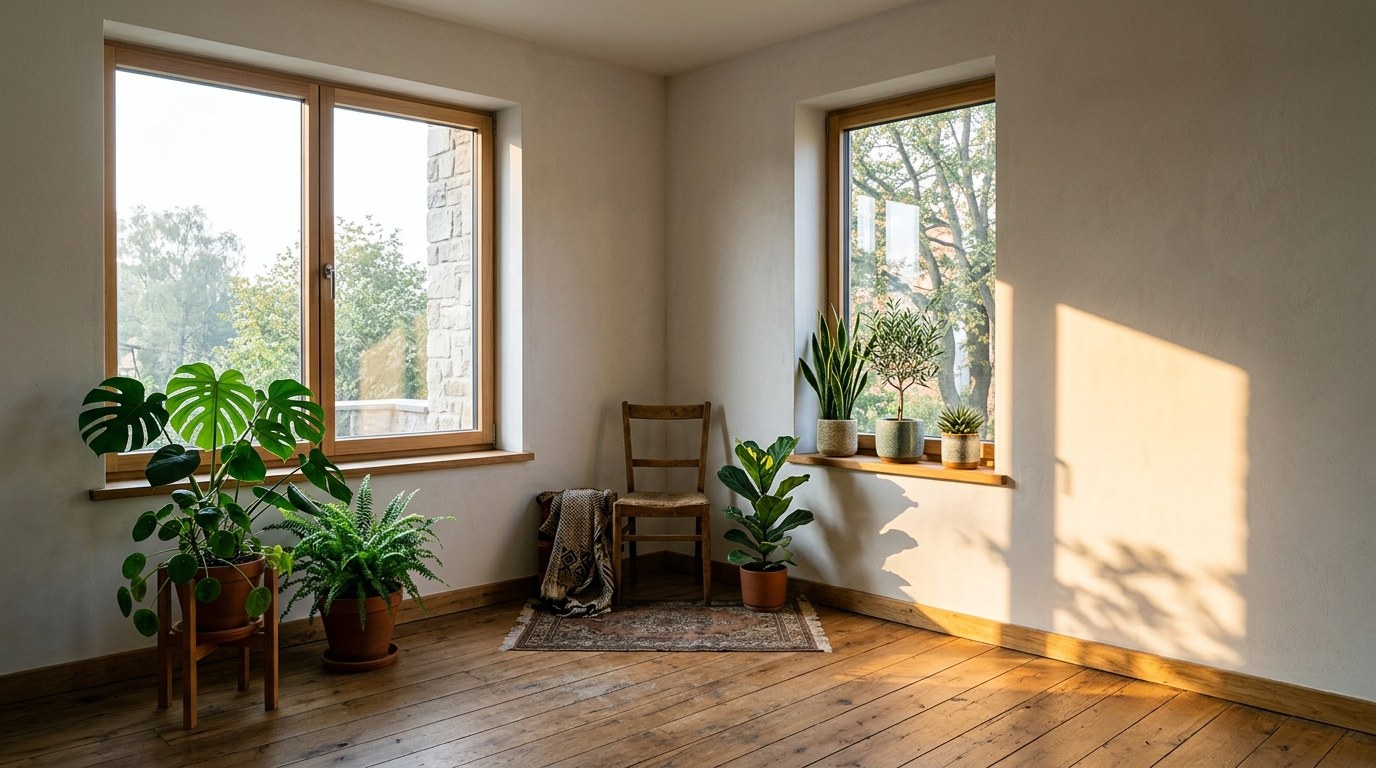
TL;DR: In the northern hemisphere, south windows give the most light, north the least, and east and west sit between them with the difference showing up in when the light arrives rather than how much. But aspect is only one of four things that decide what a plant actually receives, and it is not the biggest one. Distance from the glass, what is outside the window, and the time of year routinely matter more than which way the wall faces.
Ask which window is best for plants and you will get the same answer everywhere: south is brightest, north is dimmest, east and west are in between. That is true, and on its own it is close to useless, because it describes a wall rather than a room.
The window a metre from a neighbouring building and the window with nothing in front of it face the same direction and deliver completely different light. So does the same window in July and in January. Aspect is the first thing to know and the least decisive.
What each aspect gives you
This all assumes the northern hemisphere. South of the equator, swap north and south throughout.
North. No direct sun, ever. That sounds like a problem and is mostly a feature: north light is the most consistent light in a home, with no harsh beam moving across the room and scorching whatever it lands on. The cost is quantity. A north window is usually medium light, and in winter it can fall into low. It is the aspect where a plant is most likely to be slowly starved rather than dramatically burnt.
South. The most light by a wide margin, and the longest exposure. Sun tracks across a south window for most of the day, which means a plant sitting directly in it is in direct light for hours, not bright indirect. That suits cacti and succulents. It cooks a calathea. A sheer curtain converts a south window into one of the best positions in the house, because you keep the quantity and lose the beam.
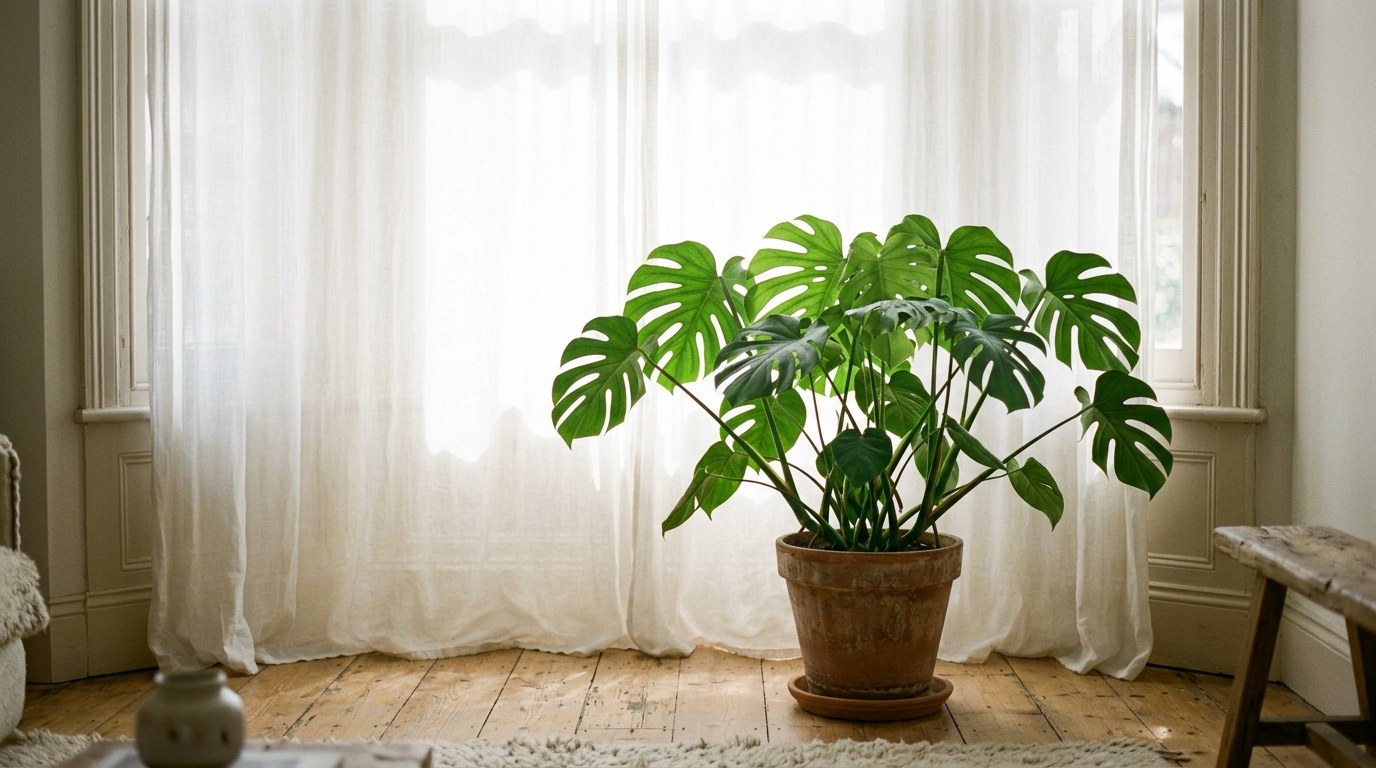
East. Direct sun in the morning, when it is at its weakest, then bright light without the beam for the rest of the day. This is the aspect that most closely matches what "bright indirect light" is supposed to describe, and it is the one that needs the least intervention. If you have a good east window, put the fussy plant there.
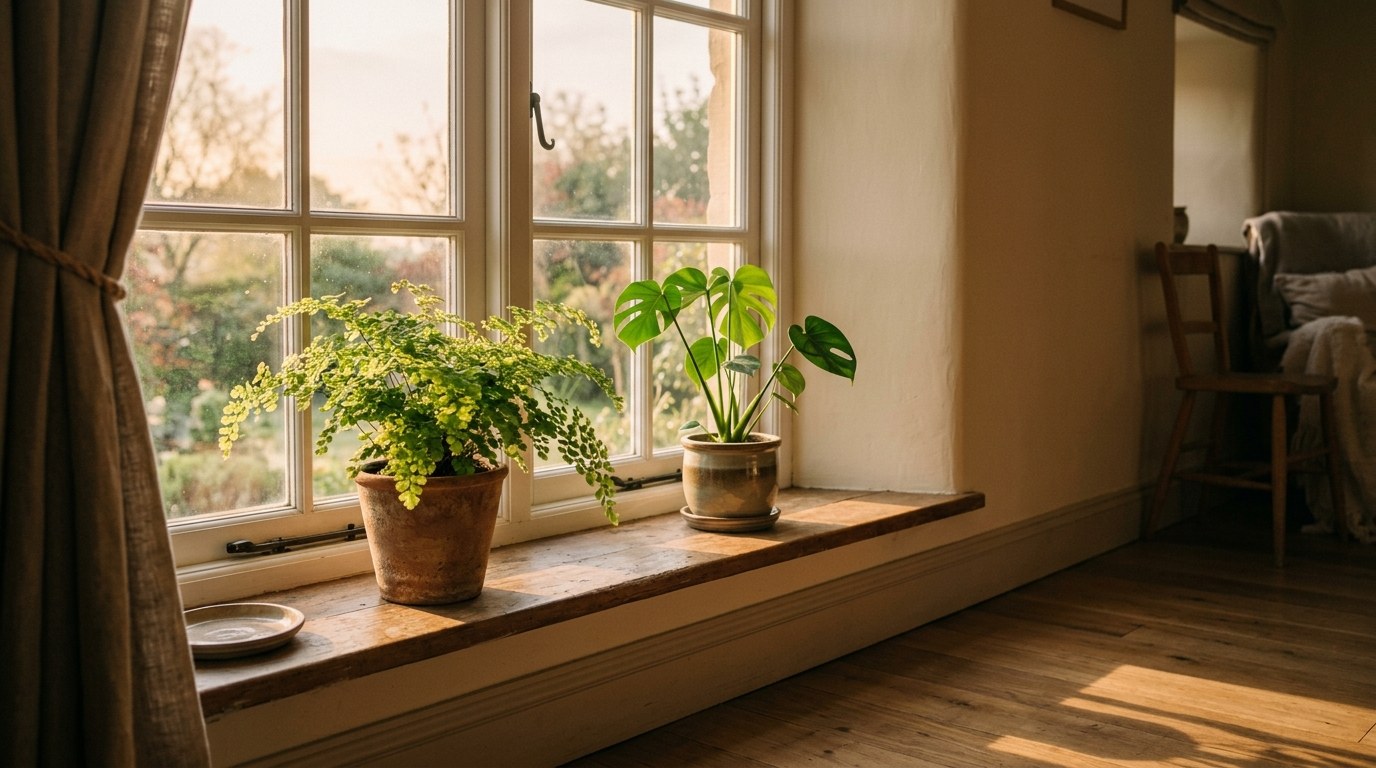
West. Similar totals to east, arriving at the opposite end of the day, but the afternoon sun is hotter and comes after the room has already warmed up. West windows tend to be harsher than their numbers suggest, and heat stress can show up on a plant that is technically getting an appropriate amount of light.
The three things that beat aspect
Window direction sets a ceiling. These decide how much of that ceiling you get.
Distance from the glass. This is the big one and the one people underrate. Light drops off sharply as you move into a room. Stepping a plant back a metre from the window can easily halve what it receives. A pot on a south windowsill and a pot on a shelf across the same room are in genuinely different light categories, despite both being "in the south-facing room". A north windowsill can beat a south bookshelf without much trouble.
What is outside. A window's aspect describes the wall, not the sky. A south window facing a building six metres away, or under a balcony, or behind a mature tree, may deliver less than an unobstructed north one. Overhangs matter a lot in summer, when the sun is high enough for a balcony above to shade the window through the brightest part of the day. Nobody's plant tag accounts for the building opposite.
Glass size and glazing. A full-height window and a small one on the same wall are not comparable. Modern low-emissivity double glazing also cuts light transmission, and coated or tinted glass cuts more. Two flats with identical floor plans on the same street can differ noticeably because one was reglazed.
Season, which beats everything. At the latitude of northern Europe the difference between June and December is not subtle. The sun is much lower, the days are much shorter, and heavy cloud is the default rather than the exception. A spot comfortably in bright indirect light in July can be medium or low by January. This is why a plant that was fine all summer starts declining in November, and why the usual response, watering it more, makes things worse rather than better.
So which window should you use
The honest answer is that the aspect narrows it down and then you have to check the actual spot.
A reasonable default, if you do not want to measure anything: put light-hungry plants at an east window, put succulents and cacti at a south window, and put the tolerant plants like snake plants, pothos and ZZ plants at north windows or further into the room. That will not go badly wrong.
If you want to do better than a default, measure the spot. The reason is that all four modifiers above are specific to your flat, and none of them are visible from a plant tag or a general guide. Your north window with nothing in front of it and your neighbour's north window facing a wall are not the same place.
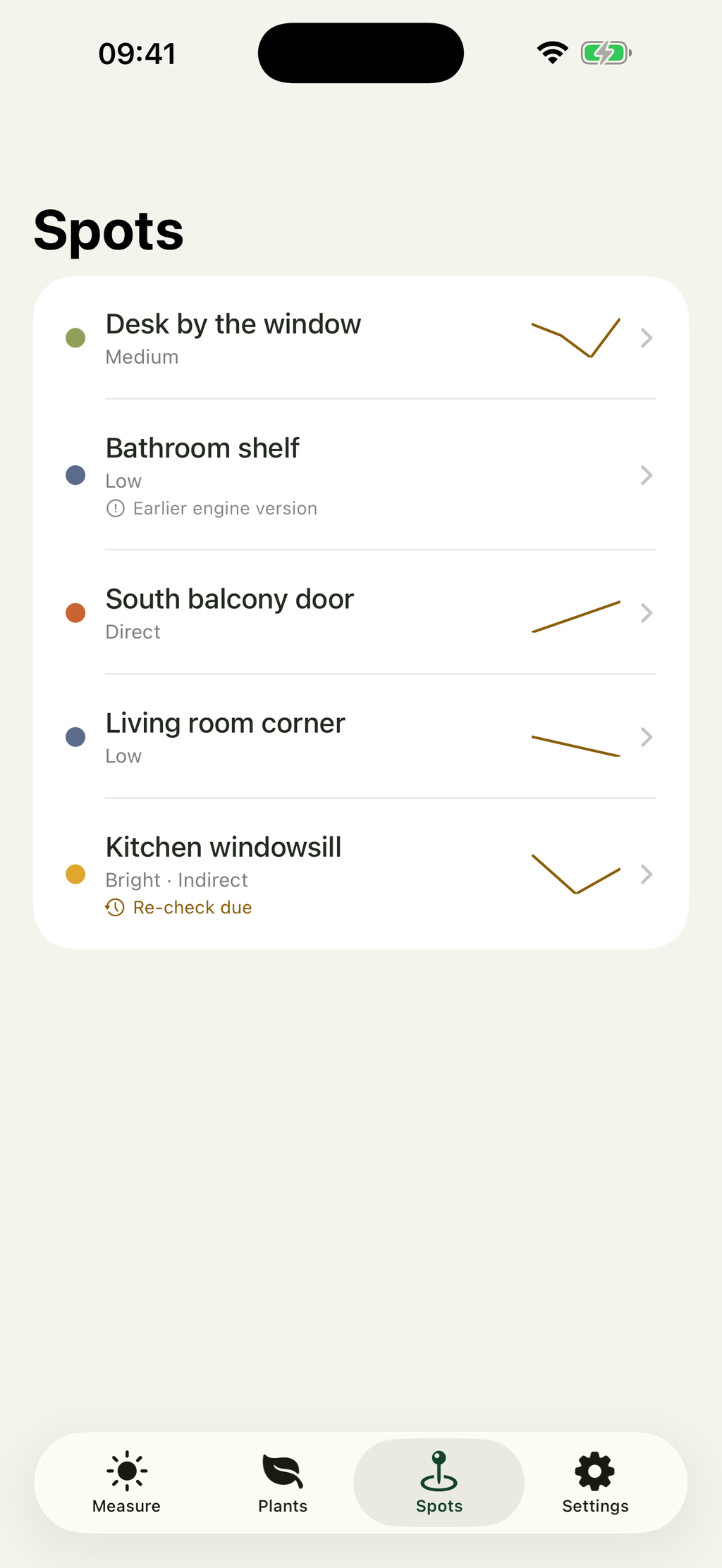
Solspot does this by reading the light sensor behind your phone's front camera. Lay the phone flat where the pot will stand, screen toward the light, and it reports the level in lux, the category it falls into, and the range that number could honestly sit in. Nothing is photographed. It then matches the reading against 100 species, so the result is a list of what will live there rather than a number to go and research.
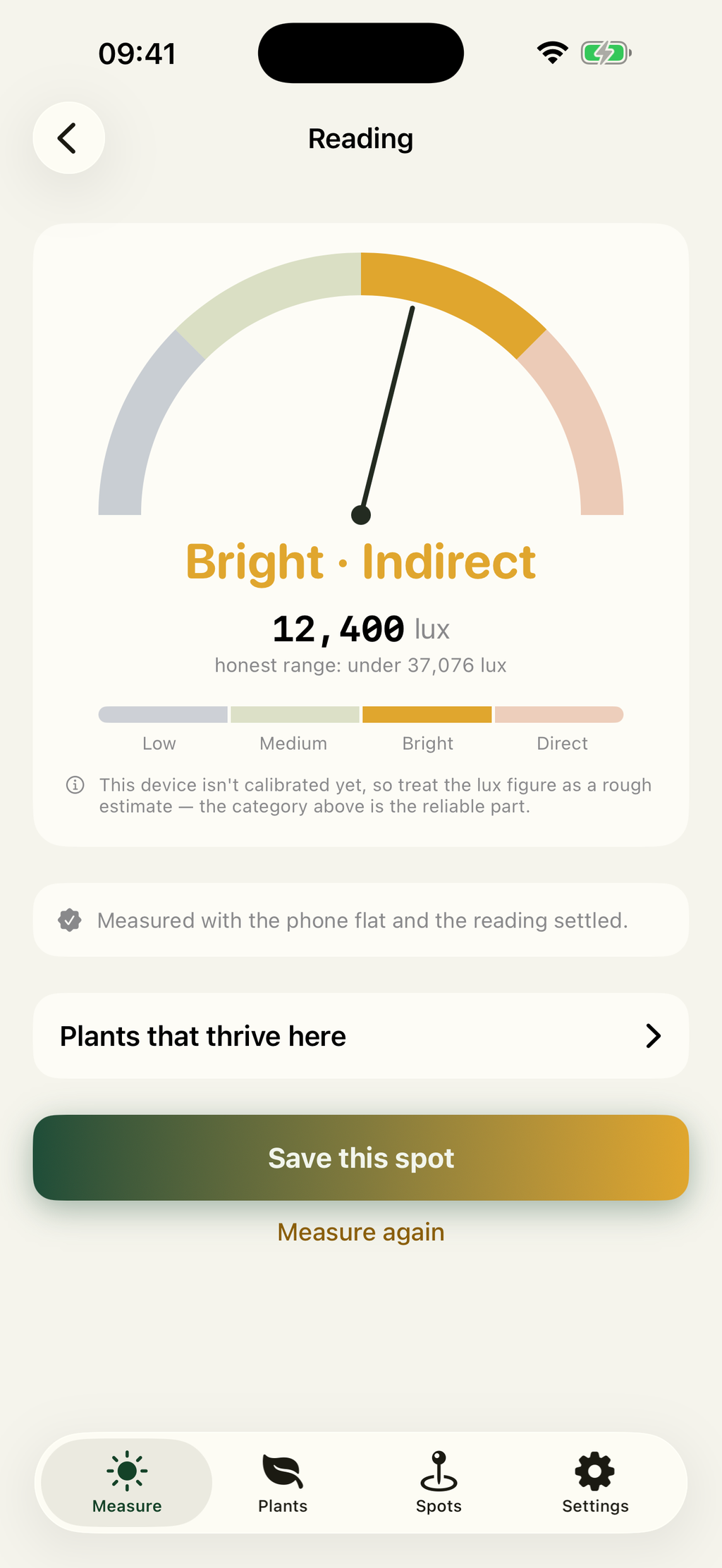

The categories it sorts into are the ones the rest of this post has been using:
| Category | Lux |
|---|---|
| Low | Under 2,500 |
| Medium | 2,500 to 10,000 |
| Bright indirect | 10,000 to 20,000 |
| Direct | Above 20,000 |
A phone sensor is not a laboratory instrument. It sits behind glass that may be smudged, it is calibrated for adjusting your screen rather than for photometry, and two devices can disagree. Solspot attaches a range to every reading for that reason, and widens the range when your device has not been calibrated.
What that means practically: do not trust the third digit, and do trust the comparison. "Is this window brighter than that one" is answerable even by an imperfect sensor, because the same error applies to both readings. That happens to be the exact question this post is about.
If you want precise growing figures rather than houseplant categories, Photone is the better tool and goes considerably deeper on that. Solspot does not try to compete there.
Measure both, on the same day
The comparison that actually settles an argument about your own flat takes about a minute: measure the north spot and the south spot within a few minutes of each other, on the same day, under the same sky. Same conditions, same sensor, same error. Whatever difference is left is real.
Then save both spots and do it again in December. That second reading is usually the surprising one.
Solspot is free on iPhone and iPad, runs entirely offline, and has no account and nothing to buy inside it.